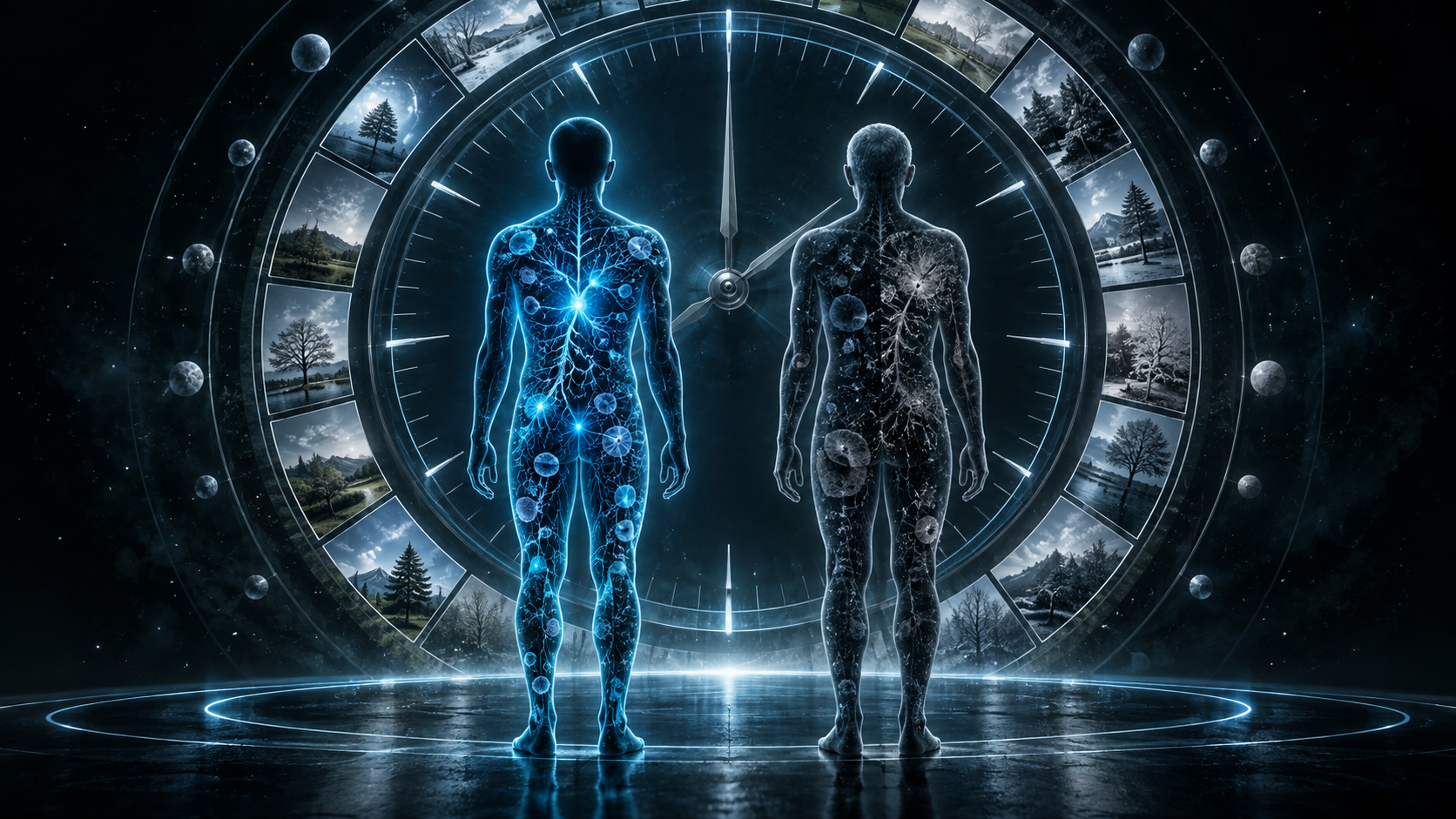
For a while, the phrase “because of aging” had been bothering me.
Blood vessels stiffen with age. Muscles weaken with age. Metabolism slows with age. These are ordinary explanations, and I used to hear them without thinking much about them.
While considering blood pressure and blood vessels, though, a question occurred to me: is getting older itself the cause?
Two eighty-year-olds don’t necessarily have bodies in the same condition. One may retain considerable muscle strength while the other has lost much of it. Their blood vessels and internal organs can differ too.
Does saying “because they’re eighty” actually explain why this particular body is in its current state?
I’m not trying to deny the effects of aging. I simply felt that knowing someone’s age leaves other things we still don’t know.
Age isn’t a number assigned after examining your body
The age we normally use counts the years since birth: forty-eight years means forty-eight years old; eighty means eighty.
We don’t measure muscle mass or examine blood vessels to determine that someone is eighty.
Age tells us elapsed time counted by clocks and calendars. It isn’t the result of examining that person’s body.
Of course, it is an important clue. Many changes accumulate through a long life, and some diseases become more likely at older ages.
But inferring something about a body from age differs from knowing specifically what has happened inside it.
Being told someone’s blood vessels changed because they’re eighty can feel explanatory. It doesn’t tell me exactly what changed in those vessels.
For example, there’s a YouTube video called “Shadowboxing at 70!” posted by Kiyotaka Higashi. Its description says he has been seventy for about forty days.
The sharp punches and light footwork look completely different from the movement I might imagine on hearing that age.
Video: Kiyotaka Higashi, Art Studio K — “Shadowboxing at 70!” (Japanese)
One comment asks whether he’s really seventy, saying it’s amazing. A viewer who boxes in their fifties says it’s encouraging.
Part of that surprise probably comes from the gap between what we expect of a seventy-year-old and the movement in front of us.
A short video can’t establish someone’s overall health, of course, and it doesn’t mean everyone can move that way.
But if I want to know how well a person moves, I need to look at the movement, not only the age.
Spending the same year doesn’t mean the same bodily change
Imagine two people who turn fifty on the same day and become fifty-one a year later.
One may have become ill while the other began exercising. Sleep, food, alcohol, and activity may all differ.
A year later, one may have lost strength and developed worse blood pressure, while the other gained strength and improved their blood pressure. That can happen.
Yet both have become one year older.
Improved strength or blood pressure doesn’t mean aging itself has reversed. But gaining a year of age isn’t the same as every part of the body deteriorating by an identical amount.
Those differences aren’t determined by personal effort alone. Genetics, disease, and living conditions can include things people can’t choose.
Even within one body, muscles, blood vessels, bones, and the brain don’t all change in the same way.
It’s easy to say both people aged a year. That tells us almost nothing about how their bodies changed differently.
Thinking about this, I somehow found myself remembering relativity.
Where is the resemblance to relativity?
In relativity, clocks that follow different paths under different conditions of motion or gravity can record different elapsed times when brought together again.
For example, one person stays on Earth while another travels through space near the speed of light and returns. When they meet, the time each has experienced isn’t the same.
This isn’t merely a mechanical clock running slowly. The elapsed time differs for each person, including their body.
The aging question here, meanwhile, concerns different bodily changes during the same year of ordinary life.
Relativity concerns different elapsed times. My example concerns different bodily changes within the same elapsed time.
The physical mechanisms are separate. What looked similar to me was that looking at one clock shouldn’t lead us to assume identical elapsed time on other clocks, or identical changes in bodies.
In everyday life, treating a year as the same year for everyone works perfectly well. We needn’t infer from that number that the same things happened inside their bodies.
“Because of aging” needn’t mean we understand the cause
I’m not saying the medical expression “because of aging” is wrong.
If it summarizes various changes progressing in the body over time, that is understandable.
What bothered me was how easily hearing that convenient expression can make us feel we’ve understood the cause.
What changed? Why? Which aspects can’t be altered, and where might intervention be possible? “Aging” alone doesn’t answer those questions.
Things in the body break down, repair, and are replaced. Such changes accumulate over a long period to produce the body as it is now.
Rather than ending with “because eighty years passed,” it feels more natural to ask what happened in this body during those eighty years.
Instead of concluding that nothing can be done because of age, look specifically at the muscles or blood vessels concerned. Change may not be possible, but age alone needn’t end the investigation before it begins.
Age gives information about the clock; aging concerns the state of the body.
The two are strongly related. Knowing the age alone still doesn’t mean understanding the body.
I continued by asking what the word “time” itself refers to in “Before saying time doesn’t exist, what do we mean by time?”.


コメント