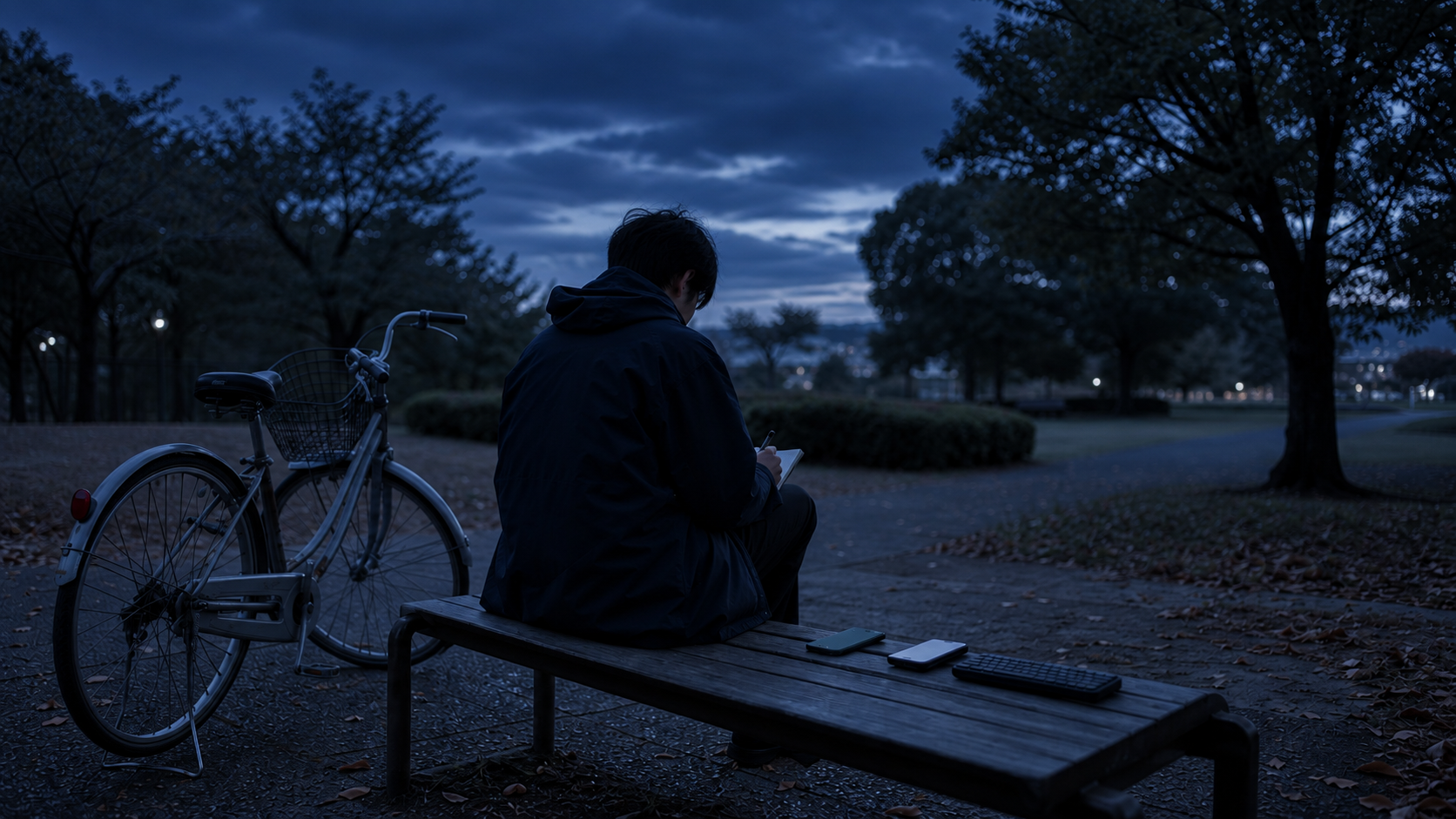
Once, while writing in a convenience store’s seating area, I thought I might already be a digital nomad before going abroad.
I recorded that day in “Maybe I’d already become a digital nomad before leaving Japan”.
I was at my usual convenience store with the same phone and folding keyboard, still between deliveries.
Yet with less fatigue after centering my food on low-temperature-cooked meat, I could enjoy writing outside rather than think only about recovering for the next delivery.
This time, I completely lost that state and recovered it. That made clearer what had allowed this life to feel like a journey.
Could low-temperature-cooked meat let me drink without a problem?
The physical change after making that meat central to my food felt substantial. Fatigue lingered less after long bicycle shifts, and I had energy to write outside.
It felt as though the foundation of life had risen a level. Then I tried an ill-advised experiment.
“If my baseline has improved this much, perhaps drinking won’t bring me down as it used to.”
I consider not drinking very important. I’m the person calling a planned book Just Stay Off Alcohol. What was someone like that doing testing this?
I’d repeatedly seen how alcohol could damage my life. Even so, I wanted to know whether food changing my body this much had changed those conditions too.
Several days after restarting drinking, the old physical decline wasn’t especially apparent. I retained relatively light movement, so initially it seemed manageable.
My mental state, however, had become something entirely different.
In Mugen Mode, I could feel bliss in the simple repetition of cycling, collecting an order, delivering it, and moving to the next one.
After drinking, the exact same repetition became intensely boring. My legs worked and my body wasn’t as heavy as during earlier drinking periods, yet I didn’t want to keep doing it.
I didn’t dislike it because it hurt. I disliked it even though it didn’t.
What follows is my hypothesis.
Perhaps alcohol’s strong stimulation made previously satisfying quiet hours feel insufficient, leaving me wanting stronger stimuli or something different to happen.
While drinking, alcohol itself provides stimulation. When trying to pass time without it, something feels missing and I can’t settle.
Rather than suddenly losing persistence, the state in which I received satisfaction from repetition had changed. That interpretation fits my experience this time.
Even then, I cycled for long hours every day for several days. Perhaps that movement made the physical changes less obvious, but I can’t separate those effects.
Later, distrust of Uber led me to stop working. Once movement fell and the routine changed, my body deteriorated sharply too.
Sleep and eating became irregular, emotions rougher, judgments careless, and the desire to write faded.
Receiving an unexplained warning and reconsidering my relationship with the job is described in “I’m still delivering, but I’ve let go of being a delivery driver”.
I don’t mean alcohol directly produced everything on its own. But for me, there’s no doubt it triggered this chain.
That’s why the book is called Just Stay Off Alcohol.
Stopping won’t instantly erase debt. But for me, stopping first is necessary to rebuild life and repay it. Once alcohol disrupts my condition, work, writing, and handling other problems become harder.
Could low-temperature-cooked meat let me drink without a problem?
The result: no.
Work became mere drudgery again
After deciding how to deal with Uber and making the necessary preparations, I resumed deliveries. During the first two days, though, riding was terribly boring and work itself unpleasant.
I even thought while cycling, “Was I really planning to keep doing this?”
Distrust of Uber remained too. I went as far as considering whether this was the moment to switch to temporary employment.
Meanwhile, the desire to write outside had disappeared.
The phone and folding keyboard were there, as were the convenience stores and parks. I had some time, but still didn’t want to write.
Same bicycle, city, equipment, and job: when my physical condition deteriorated, a life that had felt like travel became drudgery.
No attempt to interpret it as a journey could make that work.
Today, the journey returned
Several days had passed since stopping alcohol again and returning to food centered on low-temperature-cooked meat.
Today, during deliveries, that feeling returned for the first time in a while: “This feels like traveling.”
Distrust of Uber hadn’t vanished, nor had the debt. I was still cycling for income.
Yet today I wanted to write, entered a park, and sat on a bench. I’m actually writing there now.
In poor condition, I couldn’t enjoy work however often I told myself delivery was free. Once body and mood returned, the same surroundings became a journey without any strenuous meaning-making.
I could receive simple repetition as bliss and wanted to write outside. Returning to deliveries afterward wasn’t a hardship either.
In the earlier article, I felt physical conditions came first and meaning followed. This time, I experienced losing that feeling and getting it back.
Whether I can enjoy a journey
Have you watched travel videos and thought something like this?
“Why deliberately go somewhere that inconvenient and unhygienic? Japan is best.”
In one sense it’s a reasonable question. But what if your mental and physical condition at the time also helps produce the judgment?
Whether inconvenience and surprises feel like part of a journey’s pleasure or only nuisances changes the experience of the same place. I recognize that difference myself.
I spent much of my twenties abroad, but never lived as a traveler. I moved between countries and cities while establishing a base somewhere, closer to settling than traveling.
Before trips with friends or a partner, I’d think perhaps this time I’d enjoy it.
Once there, each meal left me struggling. Finding restaurants, moving, and choosing food became troublesome. Even a small demand from a partner gradually irritated me.
Others remained energetic and wanted to see this or go there. I couldn’t enjoy it. I simply wanted to return to the room and rest.
So what I enjoyed most wasn’t sightseeing, but buying beer and talking in the hotel.
I used to eat three substantial meals. Questioning that and trying two improved my condition considerably. I had more clear-headed, active time, and eventually reached one meal a day through trial and error.
I suspect eating makes me noticeably more tired than other people. I don’t dislike food. But repeated meals, movement, and choices while traveling left no energy for enjoyment.
Seen that way, traveling and working for Uber are more alike than I’d thought.
I don’t know what will happen and sometimes deal with people who ignore rules. Each time, I have to adapt, handle trouble, and let unfairness pass.
In poor condition, that was simply a burden. As looking after my health gradually worked better, traveling and digital-nomad life began to interest me.
If I could find conditions allowing my present food routine elsewhere, perhaps I could move while maintaining a state that suits me. That makes plans to go abroad look different too.
In Mugen Mode, uncertain movement itself can be enjoyable. With body and mind light, I can take the next action when something happens.
Plans still change, shops may be hard to find, and small tensions with companions occur. Problems don’t vanish.
But once I’ve done what’s necessary, I needn’t keep thinking about it. Unpleasant feelings no longer remain to ruin the whole day.
The destination’s conditions matter, but I can’t separate them from the state of the person enjoying it. Whether I can enjoy travel is also a way for me to recognize that state.
What I wanted to change was the amount of labor and who controlled it
This wasn’t my first recognition that physical work is necessary for me.
Even if blogs and books alone covered my expenses, I’d still move. I need it to maintain my thinking, mood, and writing.
Now I work long hours for expenses and debt. Later, I’d do the amount that supports my body and creative work. The difference isn’t whether I work, but how much and who decides.
I later wrote separately about how I’d like to combine delivery income with income from blogs and books.
Move through a city, use my body, stop to write Mugen no Hamon, and record the life. That life has already begun.
The future may be less a different life than a reduction in the proportion of this one devoted to compulsory labor.
And what made it possible as digital-nomad life was my body, not the location.
Writing in convenience stores or parks and riding a bicycle aren’t automatically enjoyable. The same form of life becomes drudgery when my condition collapses and a journey when it improves.
In a regional city’s park, in the middle of a journey
I’m writing in a park in a regional city. My bicycle is beside the bench, and afterward I’ll return to deliveries.
I’m neither abroad nor in a tourist destination, and the debt remains. Even so, I’m certainly in the middle of a journey.
Later note: subsequent experiments
The main text records the first period when I tried drinking again. In a later experiment, returning to my present benchmark took about two weeks. I record that separately from the earlier experience of the journey feeling returning after several days.
Since then, I’ve also tested food conditions including okra and peanuts.
The change after removing peanuts led me to stop eating nuts generally. I don’t miss them and feel better without them.
The present combination is in the six habits, and the state itself is described in “What is Mugen Mode?”
In a later experiment bringing carbohydrates back for several days, I again observed deliveries becoming boring while my legs still worked.


コメント