
I want to write books, exercise, and keep learning languages. Yet I put troublesome things off or get absorbed in something interesting right in front of me, and days pass without my starting.
I’ve repeated that pattern many times. The method I use to address it is CBS.
I register the activities I want to keep up in a counter app and add one count whenever I do even a little. My priority is to start every activity on that day’s list at least once.
One line of a book or one repetition of an exercise is enough. Rather than trying harder to increase the quantity, I make the task small enough to start.
CBS stands for Counter Breakdown System, my own method of building habits, developed and revised in everyday life. This page explains the current basics.
First, tap every counter
I register the activities I want to keep up in a smartphone counter app: writing books, organizing the blog, exercise, or language learning, for example.
I use the free “Multiple Counter” app
The screen shown here is from the iPhone app “Fukusuu Counter” (Multiple Counter), developed by EIICHI KOMINE / AppTime. It is free to use, and its App Store listing indicates advertising.
The developer’s introduction to Multiple Counter / View the app in the App Store
On Android, Tally Counter by BizNode Inc. on Google Play is another option. It’s free to install, with ads and in-app purchases. Its developer differs from that of the iPhone app shown here.
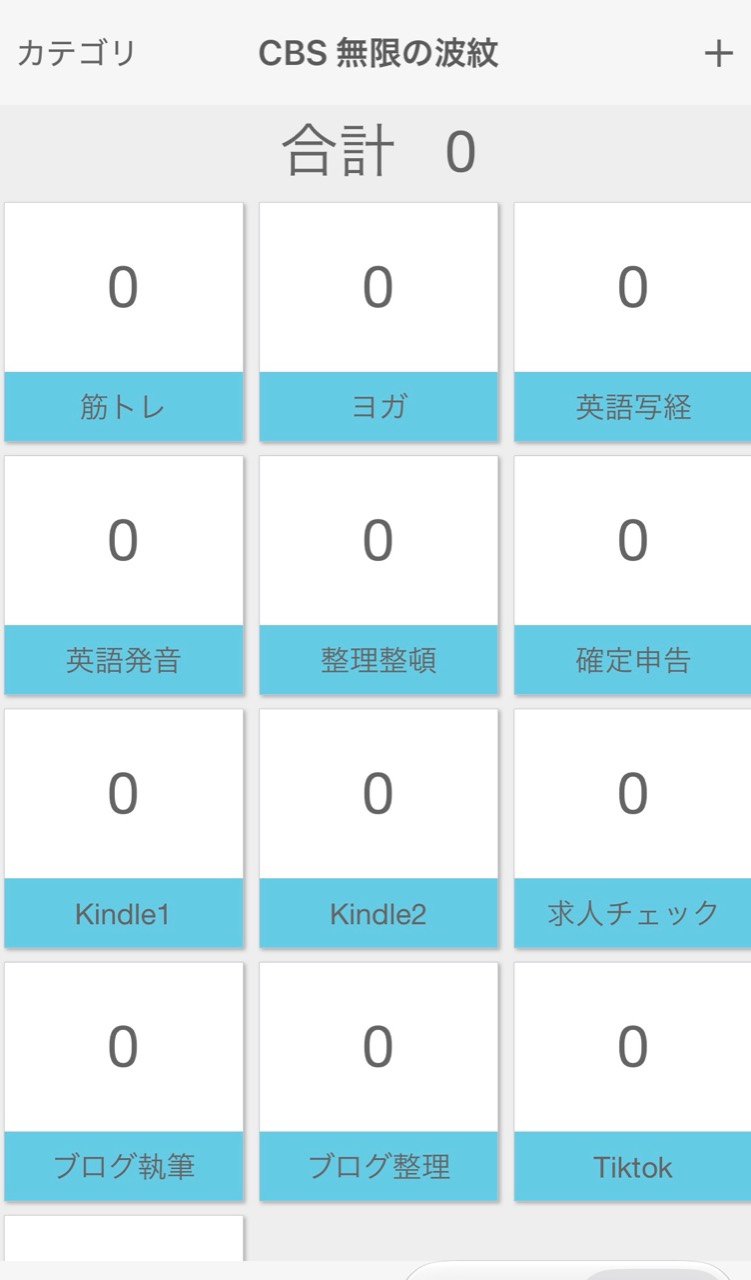
For exercise on this screen, one repetition can count. For blog writing, one line can count. Book work can also be divided into separate counters such as Kindle1 and Kindle2.
The screen contains many items, but there’s no need to match that number. Register only as many activities as you can touch on within your present life.
CBS doesn’t require this particular app. Anything convenient that provides separate counters and lets you record one count per activity can work.
Do a little, record one count
Whenever I do even a little of an activity, I increase its counter. Whether I write one line or for an hour, one count is enough to record starting it that day.
Before doing a lot of one activity, I go through all the registered items. Once I can confirm I’ve started everything today, the day’s goal is reached.
Thinking one line is too little makes it troublesome again. In CBS, almost absurdly little is fine. The minimum task is small precisely to reduce the days that end without doing it.
What a day with five activities might look like
Suppose I register book writing, a new business, organizing the blog, exercise, and language learning. Even the following is enough to tap each counter.
- Book writing: Open the current manuscript and revise one line.
- New business: Briefly check where yesterday’s work left off.
- Organizing the blog: Review one older article.
- Exercise: Do just one repetition.
- Language learning: Review one short English sentence.
Those are examples, not a requirement to have five counters. Limit the list to activities you want to keep up and can touch on in your present circumstances.
One revised line won’t finish a book, and one repetition won’t transform a body. But the fact remains that today I touched an activity I might otherwise have left for days.
For me at least, that brings a small satisfaction. After tapping all the counters, I feel I’ve properly done things today.
Starting small doesn’t mean I have to keep going
Opening a manuscript sometimes makes me want to write more. I can continue if so, but that doesn’t have to happen every time.
If there are untapped counters, I move to them. Prioritizing a start on everything also prevents hours on one task from stopping all the others.
For me, writing a little, moving my body, and doing another task leaves both body and mind lighter than prolonged absorption in one thing. The pleasure of switching activities is another reason I use CBS.
Moving between activities also weakens the feeling of having invested so much effort in one thing. I find that pleasant too.
I do a little each day and eventually find something I wanted to make has taken shape. Work progresses with the lightness of simply living. That’s another reason for using CBS.
After covering everything, I can spend extra time or energy on whatever I like. A productive day doesn’t raise the next day’s minimum.
Even after writing for an hour, one line is still enough the next day.
I don’t assume I’ll work equally hard every day. I preserve a minimum small enough for busy or tired days.
It began when I didn’t want to do anything
I developed the beginnings of CBS when I drank, did nothing, and borrowed to cover expenses.
Rebuilding my life was too big a thought to get my body moving. So I broke it into looking at one job listing or filling in part of an application.
Rather than waiting until I felt determined to change my life, I worked on one task I could do right then. I recorded that period in “Motivation can stay dead. I can still move,” in Episode 0.
Even when I wanted to act again, I didn’t make progress on everything I wanted to do. I’d get absorbed in researching a new project while the book I’d long wanted to write stalled. Now the problem was too many interests and uneven attention.
On days when I want nothing, I make starting easier. On days when I want many things, I touch the others before one activity uses all my time. I use the same mechanism for different reasons.
If it doesn’t continue, revise the setup before the effort
I’ve repeatedly introduced CBS into my life, then gradually stopped using it. Setting it up once doesn’t make it last forever without attention.
Too many items make tapping everything a burden. Even tasks taking seconds become troublesome in large numbers. Adjust the activities to current work, energy, and available time.
If starting an item feels heavy, shrink the task. Revise one line instead of writing a chapter. If that’s still too much, lower it to opening the manuscript.
Whenever it stopped working, I reconsidered how I used it. Rather than scolding myself into trying harder, I looked for a setup in which I could actually start.
When my body is in poor condition, even tiny tasks are unappealing. For me, both parts were necessary: making it possible to act through food, sleep, and not drinking, and deciding what to start.
I’ve also written about the relationship between body and action in “What is Mugen Mode?”
End the day without unfinished tasks or lingering regrets
Quantity isn’t the only reason I use CBS.
I can work for hours, then go to bed thinking of everything I didn’t do, including not opening the manuscript again. Even if one activity progresses, the others bother me and the day doesn’t feel complete.
If I’ve touched every item chosen for that day, even for seconds, I can confirm I’ve at least done everything I decided to do.
Whether the book is finished is a separate matter. I did what I chose for today. Ideally, there is no feeling of unfinished business or lingering regret.
“Today is over. Everything is done. Tomorrow’s matters can wait for tomorrow.” The day feels complete in itself.
I want to sleep satisfied with that thought. It connects with a whole life in a single day.
Make the tasks small enough to start every item each day. That’s what matters to me in CBS now.
About Trying Hard Is a Losing Game
I also plan to bring CBS together in a book called Trying Hard Is a Losing Game. It is currently one of the planned books.
This page provides the basics. Introductions and publication status will appear with the other books on the books page.