
Episode 0: I walked away from success three times and ended up ¥4.55 million in debt
From a major-label music debut overseas, through buying a suicide manual, to finally getting my body moving again: the full account.
How I became an ordinary middle-aged failure
I’m 48, with ¥4.55 million in debt. I put on a delivery backpack, get on a secondhand mamachari—a city bicycle of the kind people use for everyday errands—and deliver food to cover my expenses and pay down the debt, little by little.
Look only at that picture and I’m simply a failure. A man who grew older without becoming anyone, didn’t work, accumulated debt, and finally had to start making deliveries. That’s probably how it looks.
And it is true. I have no intention of denying it. The failure part is a fact.
But on the way here, I did have dreams of my own, worked at them, and tried to build a better life. Nor did it all come to nothing. When I was younger, I made a major-label debut in an overseas music market. Later, in sales and blogging, I achieved the sort of results people generally call success.
The problem wasn’t that I never became anyone. It was that once I became someone, I couldn’t stay there.
Those past results are at least objective evidence that not every effort missed the mark. But having been successful and having built a life that can sustain success are entirely different things.
However impressive a result was, if I couldn’t sustain it and it doesn’t support my life now, it’s just an old story. A former title doesn’t get the rent waived.
And my case wasn’t really a spectacular failure that sent me tumbling down. I moved from music to sales to blogging, got results in each, and walked away at the height of them. I wasn’t struggling to get by. If anything, it was after that struggle disappeared that I stopped being able to act.
Without understanding why, I eventually sank into drinking. Finally, I began increasing my debt to force myself to move.
If you set fire to your own house, surely you’ll run outside. That was roughly the method. It was hardly sane.
This is the story of a man who walked away from success three times and finally began moving his body to escape a fire he’d started himself.
Fame, money, and freedom over my time. I got the things I wanted, one after another.
The first results came in an overseas music market
When I was young, I moved abroad and joined a local band. Our debut single spent six consecutive weeks at number one on that country’s national music chart. The next song reached number one too, and so did the one after that.
Our music played in shops and around the city. Crowds cheered when we took the stage. We appeared on television.
Before I got there, I thought success would change something fundamental. Somewhere in me was the expectation that I’d gain confidence, stop being bored, and finally understand why I was alive.
But the results arrived and that change didn’t. Of course there were happy moments, and I was grateful to the people who supported us. Yet once the cheering stopped and I was alone, the same emptiness remained. Achieving something didn’t make the boredom disappear or give me a clear reason to live.
The bigger the numbers became, the bigger the next numbers were expected to be. I started seeing anything that didn’t contribute to them as a waste. Gradually, “Am I going to keep doing this?” became stronger than the pleasure of it.
The desire for recognition is rather like seawater: the more you drink, the thirstier you get.
Eventually, I left the band at its peak. The people around me couldn’t understand it, and at the time I couldn’t properly explain why I was giving up something I’d wanted. I simply felt I had to.
I left music and chased numbers in sales
After leaving the band, I moved between several countries before returning to Japan. If the world of creative expression couldn’t satisfy me, perhaps I could get results somewhere more “practical.” I went into commission-based sales.
I had little formal education and no conventional employment history worth talking about. Still, watching where people’s interest arose and which words moved them wasn’t all that different from music. I learned from people who were already getting results, developed my own approach, and followed it.
I became a top salesperson. My income rose, I wore good suits, and I started going to places I’d never had much to do with before. As conventional professional success goes, this was probably the easier version to explain.
All I had to do now was keep earning more. It felt as though a stable, prosperous future was opening up in front of me. But the pleasure didn’t last long.
Music and sales looked like different worlds, yet underneath I was doing the same thing: reading people’s emotions, drawing out the response I wanted, and building up numbers. All I found there was emptiness.
The following year, I quit.
I built a blog to find freedom
What I wanted next was neither fame nor recognition at work, but free time. I left the company and focused on affiliate blogging.
I researched search terms, made articles, and revised them in response to what happened. Analyzing how a system worked suited me. A blog I built over roughly three months went on earning with very little further work and eventually brought in a seven-figure total in yen. I didn’t go to an office, and money arrived even while I slept.
I honestly thought I was free. What I actually got was a life of endlessly repeated days with nothing I needed to do.
The articles I’d made for income didn’t interest me enough to keep writing them. Money came in, but I had nothing to do with myself. Freedom with no use for it becomes an enormous blank space.
Music had given me fame. Sales had given me status and income. Blogging had given me freedom over my time. I had tried three things people hold up as ingredients for happiness, one after another. None of them cured my boredom.
After I let go of the results, freedom became an enormous empty space.
I sank into drinking and bought The Complete Manual of Suicide
After I stopped working on the blog, my life gradually came apart. I drank almost every day, ate junk food, and felt foggy even when I was awake. There was no single dramatic event. I just kept doing nothing, and grew accustomed to doing nothing.
Even so, I still trusted that I could make money online, because affiliate blogging had actually earned me money before.
“If it comes to it, I can always earn online again.”
That feeling remained, but I had no motivation to start anything. I went on drinking. Meanwhile, I kept buying online courses, guides, and tools. These are parts of my actual purchase history, including that period.
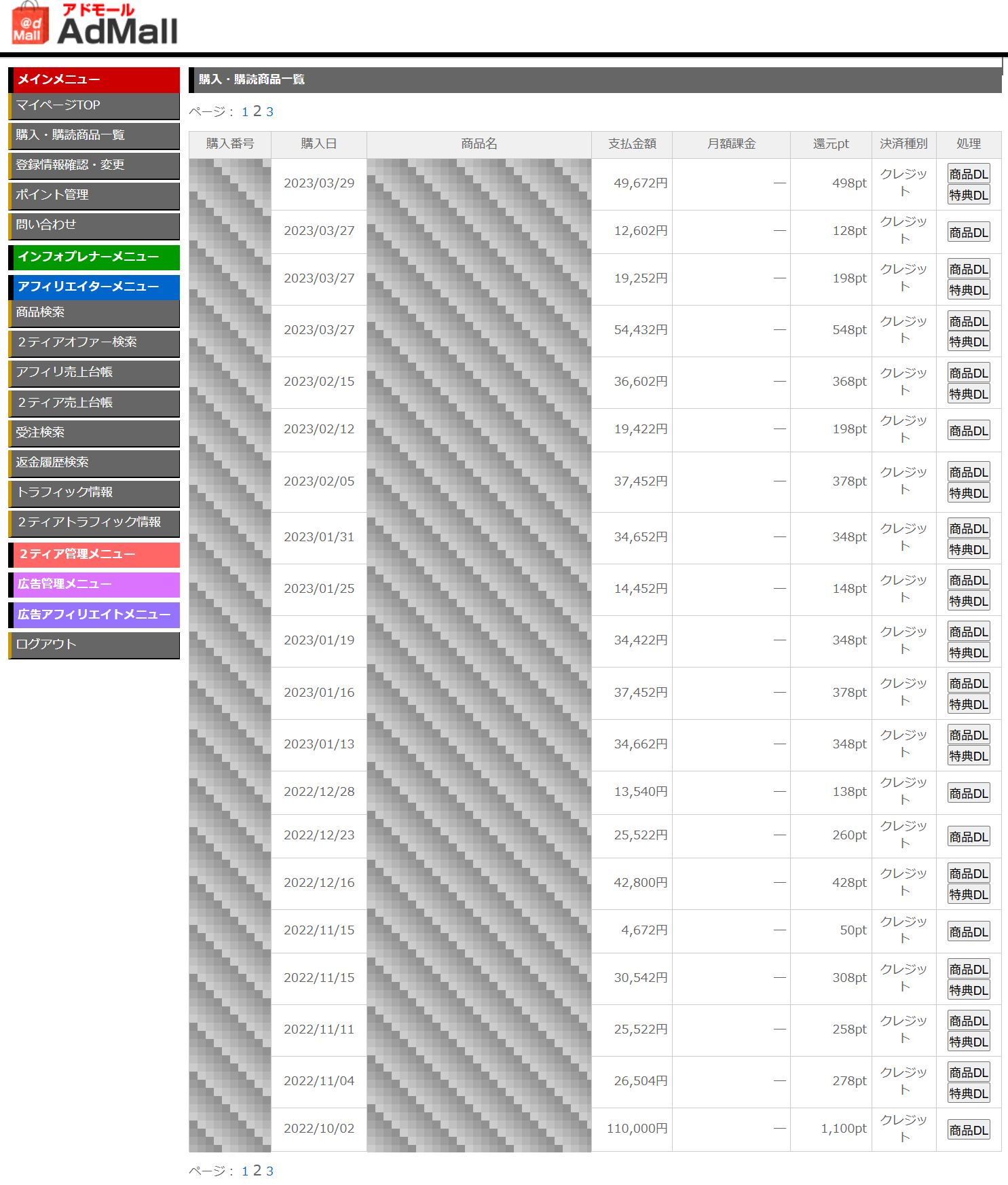
Part of my actual purchase history, spanning several years. Product names and purchase numbers are hidden. Open the image to enlarge it.
See another purchase-history image
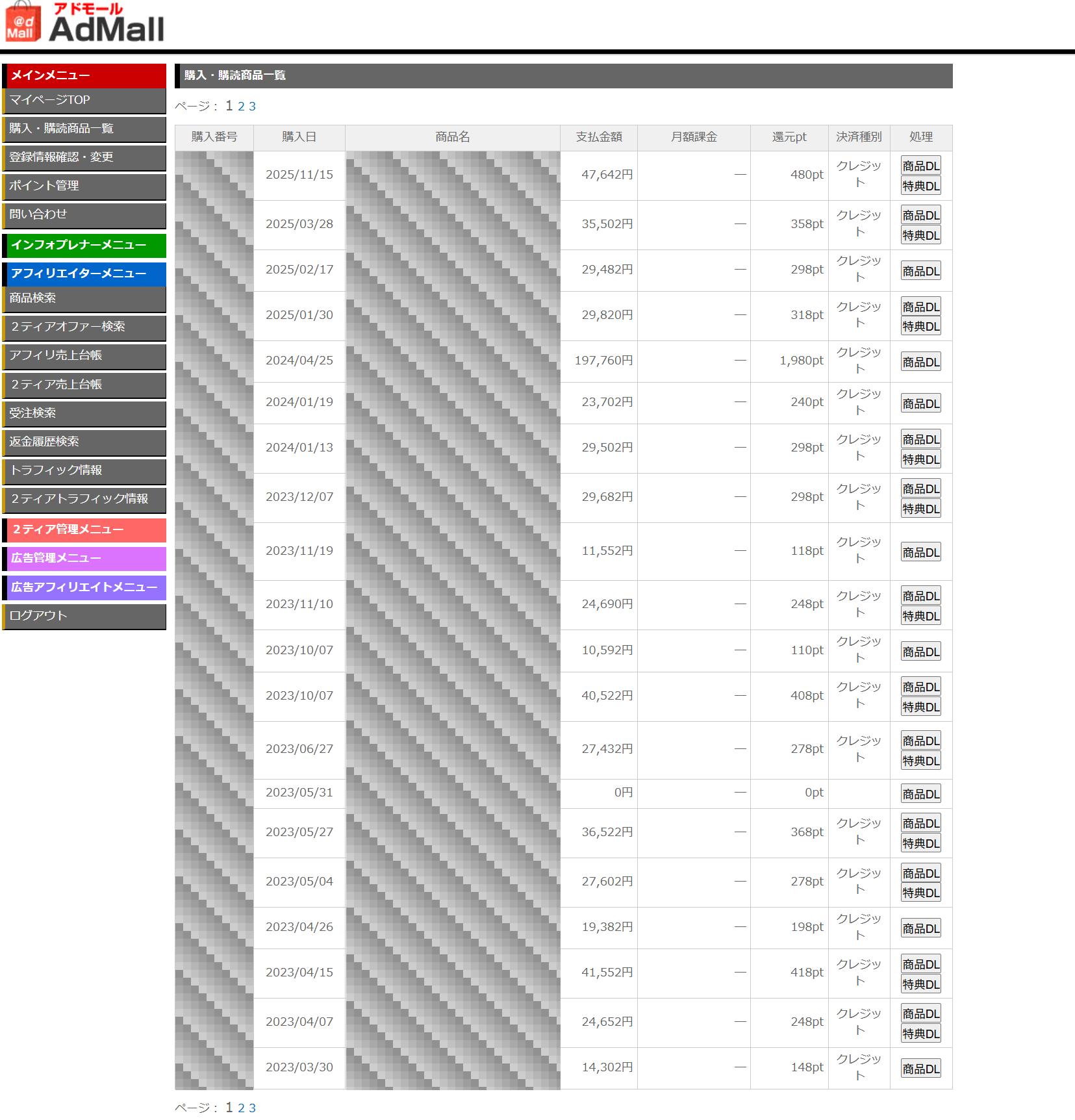
The purchases shown in those two images alone total ¥1,366,068. And that’s only the history from Admall, a site selling guides, courses, and tools.
I also spent quite a lot on note, where people publish writing and can sell it, and Brain, where people sell knowledge and practical guides. That spending isn’t included in the ¥1.36 million above.
Looking at it now, I think, “How much stuff did I buy?” But at the time, buying something was often reassuring all by itself. There was still a way to make money. If I did this, I’d be all right. It was easy to feel that way.
I did try a few things and earn something from them, so this isn’t a story about every course being useless. But I put very few of them into practice. With some, I read the contents, felt something was off, and decided not to proceed.
While telling myself I could earn again, I went on living much as before: drinking, browsing the internet, and reaching the end of another day without doing anything.
One day, while browsing like that, I ordered The Complete Manual of Suicide — Japanese book, almost on an impulse.

I turned its pages and imagined my own death in concrete terms. For me, the book was less a salvation than an emergency exit. For the brief moment when I thought, “If it becomes unbearable, I can leave through here,” I felt free. There was relief in that.
Even then, I couldn’t do it. I couldn’t die right now, but going on living like this was agony. Unable to move toward either living or dying, I spent each day drinking and passing the time. My body and my life had deteriorated enough that I’d lost even the capacity to think clearly about what to do next.
I increased my debt as though setting fire to my own house
In that state, one idea took hold of me. Perhaps I couldn’t act because I still had enough room to get by and wasn’t truly in trouble. If I created a situation with no way out, wouldn’t my survival instinct wake up and force me to stand?
So I deliberately increased my debt, using personal credit lines and revolving credit. But even when I decided to spend, I couldn’t come up with endless things I wanted. The online guides and courses I’d already been buying offered a natural place for the money to go.
Some of those purchases are included in the history above. At first, I’d bought them to make money. By this point, another motive had become mixed in: increasing the debt to corner myself. It wasn’t only courses, either. Sometimes I went out drinking and paid by card.
I tried to cut off my own retreat by putting money I had to repay behind me. If I couldn’t make myself stop running away, I’d destroy the place I could run to. In other words, I was desperate and reckless.
Set fire to your house and you may burn to death before getting outside. Increasing your debt won’t make everyone act; destroying your livelihood and your health is probably the more likely result. But at the time, I couldn’t see another way. It was a gamble with everything at stake.
I won’t call that judgment correct. There was, however, a later day when that reckless gamble came back to me in a way I hadn’t expected. I recorded it in “Hey, my old self. Looks like the plan worked after all”.
When the debt had passed ¥4 million and borrowing more had become difficult, something clicked at the back of my mind.
“…Time to die? No. Time to do something.”
I didn’t suddenly erupt with motivation or tremble with fear. I simply felt, finally and seriously, that if I went on doing nothing, it really would be over.
But how was I supposed to rebuild my life from here? If sheer grit could have done it, I wouldn’t have reached this point. After thinking it through, I decided to build a system that would get me moving, rather than try to solve it through feelings.
I stopped waiting for motivation and began rebuilding life through physical movement and practical tasks.
Motivation can stay dead. I can still move.
What I needed wasn’t a stronger resolve. My motivation was already dead, and I couldn’t afford to wait for its resurrection. Instead, I made a system for mechanically doing the tasks regardless of my mood.
This was the beginning of what I later called CBS, the Counter Breakdown System. The name sounds grand, but the practice was simple. “Rebuild my life” was too vague and too large to count as a task.
So I broke it down as far as I could: look at one job listing, fill in an application field, go and buy a résumé form. Trying to change my life stopped me in my tracks, but I could manage a trip to the convenience store. I could write my name on the form I’d bought.
By lowering the bar that far, I worked through the tasks one at a time at my own pace. This didn’t erase the debt. But I could at least get things done one by one instead of remaining frozen, not knowing what to do. When the results became visible, I began to feel a little more willing to tackle the next task.
Later, I developed it into a method of recording each day’s starts with a counter. I explain how I use it now in “What is CBS? Making tasks small enough to start everything each day”.
Physical labor was my version of enlightenment
The first work I took to rebuild my life was warehouse work and cleaning. Unlike the days when I wore a suit and chased numbers, carrying boxes and scrubbing floors brought the day’s work to a visible end. There was less maneuvering around other people too.
At first, it was hard on my body. I carried things, polished floors, and used up a day’s worth of strength. When I stepped outside after a shift, the evening air touched my still-sweaty body.
On the way home, an indescribable happiness went through me. Nothing especially good had happened. My pay hadn’t suddenly risen, and my debt hadn’t shrunk. Yet there, inside my body in its work clothes, was a feeling I hadn’t known at number one on the national music chart or as a top salesperson.
“…Oh. This was enough.”
For a moment, the ego that had been talking inside my head for years fell silent. I found myself smiling. For me, it was something like enlightenment.
It wasn’t becoming one with the universe or smiling through everything that happened. It was carrying boxes, scrubbing floors, getting hungry, eating, and sleeping. Doing those things freed me from unnecessary thoughts.
Of course, physical labor won’t save everyone. Overwork damages the body, and my current long hours aren’t ideal either. This is simply what worked powerfully on my own body after I’d stopped moving and done nothing but think.
It was then that I finally understood that a problem and the anguish surrounding it aren’t the same thing. The debt problem was still there, not reduced by a single yen at that point. Yet once I used my body and knew what I needed to do that day, most of the despair and self-rejection wrapped around it disappeared.
Instead of endlessly thinking about the debt, I could think about how much to earn today and how much to repay that month. The problem remained, but most of the anguish was gone. That was a substantial difference for me.
Success hadn’t been a condition for happiness
When I was successful, I had money, recognition, and fewer obstacles in front of me. I was still bored, with no idea what I wanted to do.
That doesn’t make poverty or debt superior. Having money and more options makes real problems easier to handle. It’s better not to have debt. That’s obvious enough, however unromantic it sounds.
But social success alone hadn’t made me happy. And now, even while I’m in debt and working with my body, there are times when food tastes good, I sleep well, and my mind is quiet.
What helped me rebuild wasn’t the debt itself. It was changing my physical condition, facing the reality in front of me, and creating a life in which I could gradually act again.
I used to think happiness existed in a future where I’d achieved the result. Now I think it’s better to deal with real problems while also looking after how I am today. Even if I’m working toward success or paying everything off, the intervening years don’t have to become an unhappy waiting room.
Then I chose food delivery
Warehouse work and cleaning showed me that movement was something I needed in my life. At the same time, the prospect of returning to a life where other people determined all my working hours and locations felt deeply constricting.
So I chose bicycle food delivery again. The income is unstable, but I decide when to go out, where to ride, and when to rest. It’s an extraordinarily free way of working.
There was also the possibility of earning my living through movement while finding time to write between deliveries and after work. It didn’t go smoothly from the start. In the quiet season, I couldn’t earn enough and even considered giving it up.
Still, before returning to employment, I decided to see how far I could make this unstable freedom work. What comes next is the ongoing story recorded here on Mugen no Hamon.
One last thing about the law of attraction
There’s something else I want to touch on in this story: what’s commonly called the law of attraction. Hold a wish strongly and imagine its fulfillment, and the universe will bring you the necessary events. Successful people’s experiences are often offered as evidence.
As I mentioned, I went abroad alone and made a major-label debut in a local band. Our song reached number one on the national music chart, and I left the band while the hits were still happening.
Viewed from the outside, those events might tempt someone to call them miraculous. They would certainly be convenient material for a story about the law of attraction.
It doesn’t have to be the universe’s plan. Chance is enough.
Even so, I don’t see this experience as proof of cosmic intervention. What happened was certainly unusual, but I have no reliable statistics telling me its odds.
When something rare happens, people want to attach meaning to it: “I attracted it,” “The universe chose me,” “It was destiny.” Say that, and you become the special protagonist of your own story. But the bare fact that something rare happened doesn’t require introducing a will behind the universe.
Luck, circumstances, encounters, and our actions came together, and a hit resulted. Calling it chance might sound cold, but chance doesn’t mean worthless. What actually happened is interesting enough without adding a cosmic production team.
What matters to me isn’t wearing an unusual past like a medal. It’s the fact that getting the results I wanted didn’t automatically put my life in order. That’s far more useful.
So now, instead of waiting for the universe to send its next signal, I’m rebuilding life from the realities I can’t escape: my body, work, bills, food, and sleep.
I describe what I currently do to look after my physical condition in “The six habits that brought bliss to my life with ¥4.55 million in debt”.
— Mugen no Hamon —
How I now define success, based on these experiences
Apart from the history of what happened, I also want to keep a record of what I used to think about. Could I live without sacrificing other people or other living things? I’ve written about that question in “Giving up on being perfectly good made life much easier”.
I’m turning these experiences and ideas into several books. The English edition of Happiness Starts with Reality is now available on Amazon Kindle. The Japanese edition is still being revised. Publication updates and the other books in progress are on the books page.