Actually, my body’s performance had been declining for a while.
In an earlier diary, I wrote that I’d entered Mugen Mode. Long hours pedaling my ordinary city bike left almost no fatigue the next day, and I could write during breaks between deliveries. My emotional response to music returned, and problems no longer lingered as they once had.
The bicycle hadn’t become electric. It felt as though the assistance had been installed in my body instead.
Giving up alcohol, eating once a day, cooking meat at a low temperature, resting before exhaustion, and reconsidering my relationship with Uber had come together. I thought I’d finally found how to manage my body and life.
After a while, though, that feeling gradually faded.
I wasn’t bedridden. I could keep making deliveries, and my bowel movements were fine. But my body was clearly heavier, fatigue clung to me after extended movement, and I had less energy to write during work or after returning home.
I didn’t examine it closely because the rainy season had ended and intensely hot days had followed.
Riding a non-electric bike under the blazing sun was bound to make me feel heavy. I assumed I’d recover once I adapted to the heat.
Something felt off, but I wasn’t looking at food as the cause.
I thought vegetables were optional if I wasn’t constipated
The clearest change at the beginning of Mugen Mode had been low-temperature cooking.
I cooked chicken and pork in batches and kept them in the fridge. When hungry, I ate one meal centered on that meat. Preparation was easy, it tasted good, and I could comfortably eat a substantial amount.
The change was large enough to notice the following morning. I described it in “Upgrading my meat-based diet: giving up the frying pan made life more comfortable”.
Something else changed after I began cooking this way. Even with almost no vegetables, I stopped getting constipated.
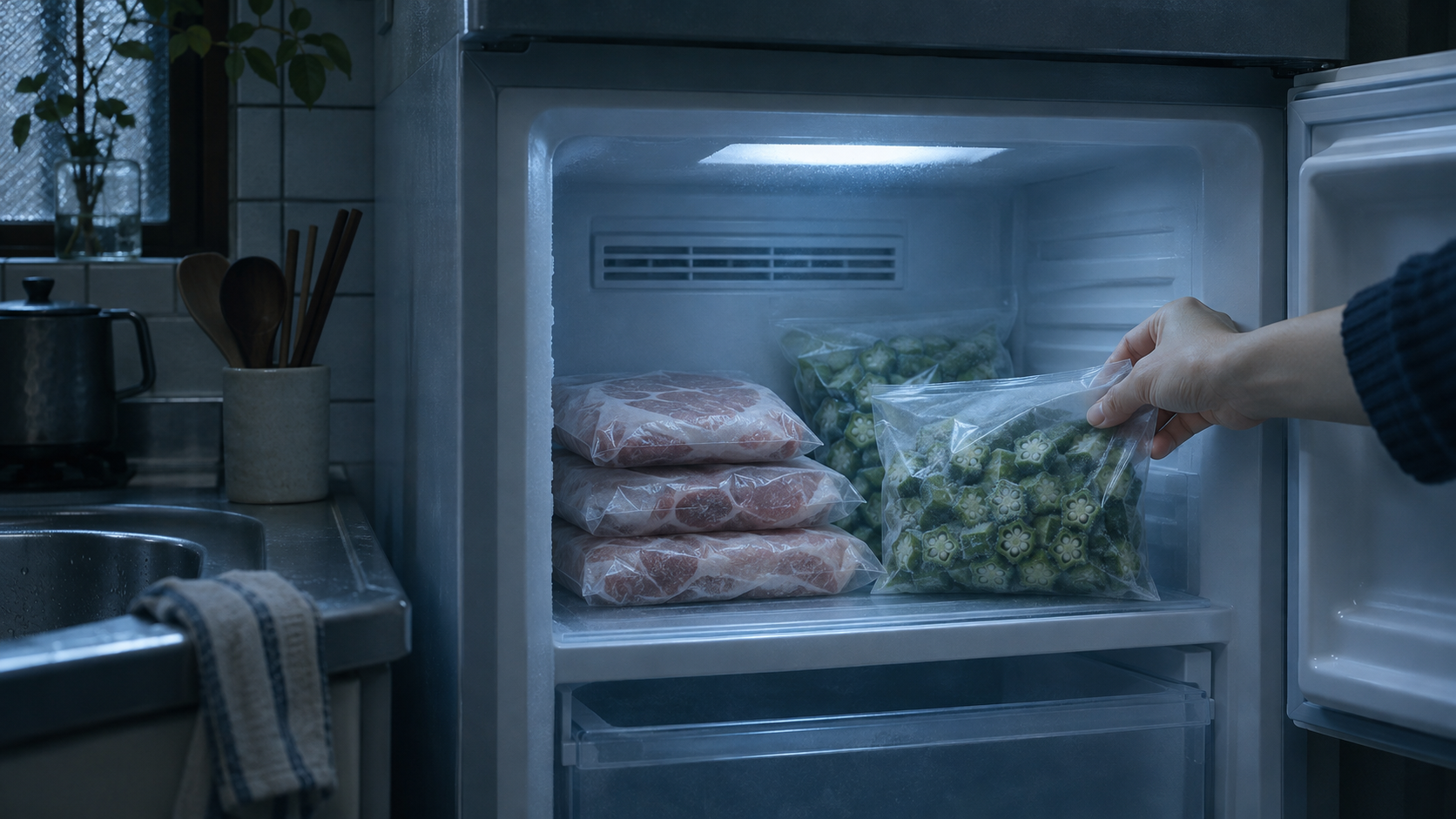
When I’d previously tried a diet centered on meat, eggs, and cheese, reducing vegetables had caused constipation within days and left me with a painful experience. Since then, I’d kept okra, broccoli, and chopped green onions in my small freezer.
This time, reducing them didn’t stop normal bowel movements. I didn’t know whether cooking method, fat, or food quantity explained it. I simply had no bowel problem.
So perhaps vegetables weren’t necessary. Not buying more would also leave room to store meat. I gradually finished the frozen vegetables and stopped replacing them. My diet became almost entirely meat.
The empty freezer made me notice
One day, as I put newly bought meat in the freezer, I paused.
There seemed to be an odd amount of space.
Frozen vegetables used to occupy more than half of it. Their differently shaped bags needed rearranging whenever I added meat. Now meat alone fitted easily.
The extra room was what I’d intended. But it suddenly struck me that stopping vegetables and developing a heavier body had happened around the same time.
Immediately after entering Mugen Mode, I’d still had vegetables left. I was eating okra and broccoli with the low-temperature-cooked meat.
After I stopped buying vegetables and moved toward an almost entirely meat diet, the lightness gradually faded.
I’d watched only for constipation. Might green vegetables also have affected my fatigue and sense of physical lightness?
I had no proof, but I had a hunch. Rather than return broccoli and green onions all at once, I first bought only frozen okra.
A suspicious middle-aged man was grinning in the heat
The result was clearer than expected.
After returning okra to my meals, working in the extreme heat felt completely different.
The temperature hadn’t dropped. It was hot outside, and pedaling made sweat pour off me. The sunshine and heat rising from the road were unchanged.
Yet deliveries flowed easily.
For the last week or two, I’d needed a break after a certain amount of riding. Now that point arrived and my legs still had strength. My mind worked, and when the next request came, I could head straight to the restaurant.
I wasn’t forcing myself past a desire to rest. I passed my usual break time without feeling a need to stop.
“Seriously? This is incredible.”
Under a blazing sky, one suspicious middle-aged man rode his city bike soaked in sweat, grinning to himself.
This wasn’t a slight improvement. It was a world apart from the previous day. Fatigue no longer clung to me after long rides, and afterward I even wanted to write.
The Mugen Mode feeling I’d excitedly recorded before was back.
I still don’t know what in the frozen okra helped
Was it fiber or some nutrient in okra? Other conditions could have overlapped: its combination with meat, water, salt, or adaptation to the heat.
I don’t know the mechanism, and I’m not claiming everyone would have the same result. But my body grew heavy after removing vegetables and clearly lighter after restoring okra, even in the same extreme heat. I observed that sequence in my own body.
It isn’t enough for a medical conclusion. It is enough observation for me to decide my next meal.
Will it continue? What if I change the amount? Do I need other vegetables back too? I can keep observing.
I’m not eating to defend a dietary rule
Learning about a carnivore diet—centered on meat and avoiding plant foods—can make it tempting to eliminate plants completely rather than stop halfway.
When I found I wasn’t constipated on meat alone, I felt I was finally approaching a pure carnivore diet. A freezer containing nothing but meat even gave me the pleasant feeling that the diet was complete.
But I’m not eating to compete over who follows the rules most strictly.
If following a rule makes me tire easily, I’d rather restore frozen okra and move comfortably. I can change what I eat according to what happens in my body.
I thought, “I’ve won”
Continuing to ride, I found myself murmuring, “I’ve won.”
Won against what? Life itself.
The debt hadn’t vanished. Uber hadn’t withdrawn its warning. Yet the value of being able to maintain this physical condition with some repeatability felt enormous.
My body and mind worked, and even after a long ride I could think about the next thing. Other jobs or learning something new, which I’d previously lacked even the room to consider, now looked possible.
I didn’t want to spend all that spare energy on deliveries, though.
Using all of it on mere delivery work would be a waste.
I’ll earn the money I need. But with that energy back, I want to use some for the blog, books, and learning. It could also help me prepare to live somewhere else.
Not collapsing on arriving home, not finding food and bathing a chore, and still being able to write: that reserve changes even how the day ends.
If I’m living by one day, one life, being capable of a few more deliveries doesn’t mean I need to use myself up. Some days, I’d rather finish with room to spare than add a little more revenue.
With this much physical and mental room, I could learn another job from scratch if I lost access to Uber. A new workplace would have its difficulties, but I don’t feel I have to cling to this one.
I’m gradually learning the conditions under which my body works well, and I have energy left for what I enjoy after working. That mattered enormously to me.
I thought low-temperature cooking had completed my diet. An empty freezer showed me I’d still overlooked something.
For now, I’m eating frozen okra with the meat again.


コメント