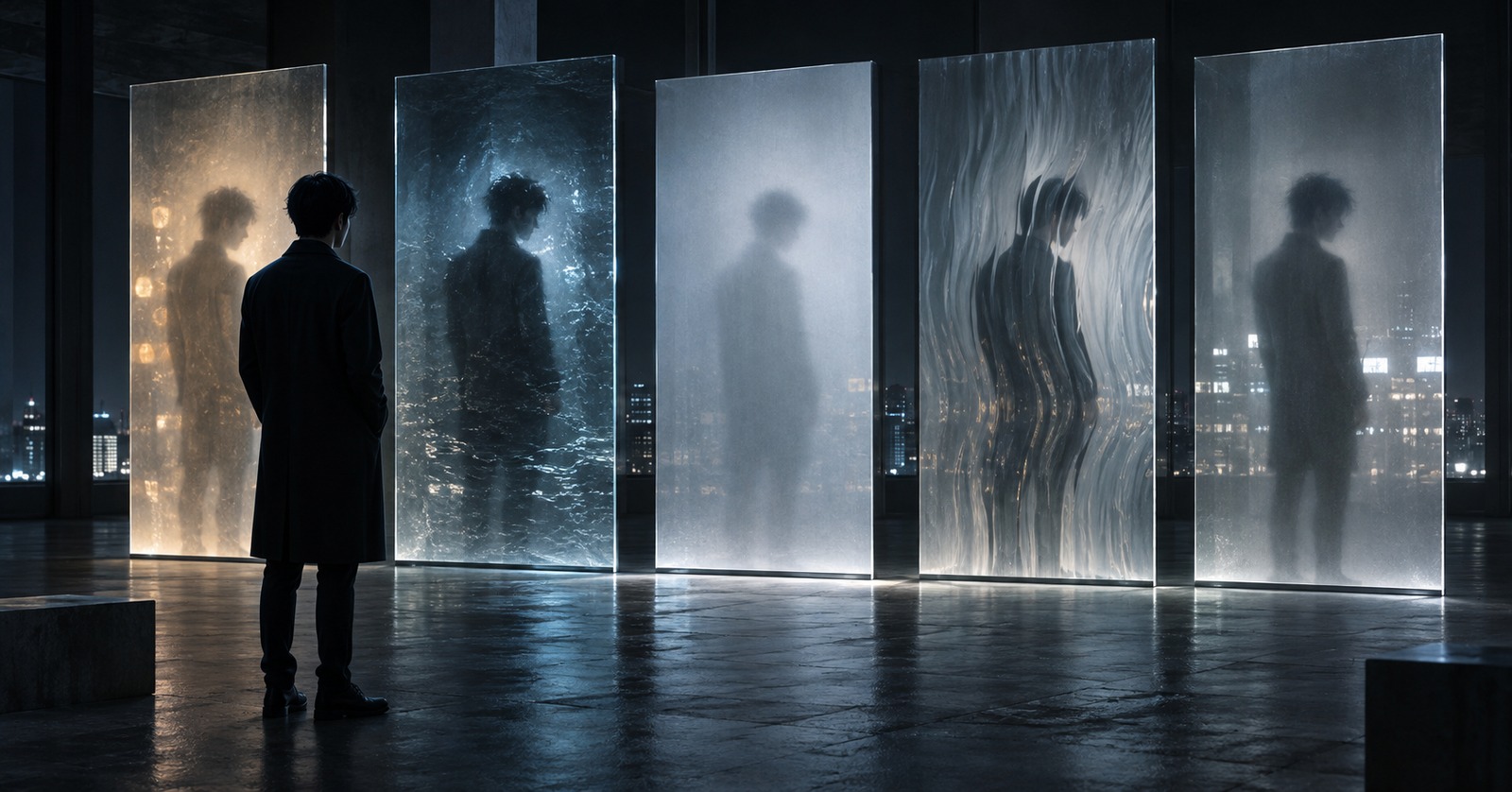
It’s easy to take the world we see as reality itself.
We look at someone and think they’re kind or unpleasant. A job may look enjoyable, or like something we could never do.
But we aren’t simply seeing the thing exactly as it is. Memories, experiences, values, and expectations are involved.
People can see very different things in the same object. I explored that through reactions to one video in “The same video, different realities”.
While thinking about this, an extreme example occurred to me.
The same mother’s death can mean completely different things
Imagine a woman called Hanako, who has one child.
First, imagine a life in which the child grows up loved by her. They hold hands, she cooks meals, sometimes scolds them, and helps when they’re in trouble. After decades together, Hanako dies in an accident.
The news would shake the child’s life. The grief might last far beyond that day. Years later, a view, a food, or a casual remark could bring their mother back to mind.
Now imagine another life. The same Hanako gives the child up before they’re old enough to remember. The child grows up elsewhere, knowing neither the name nor the face of their birth mother.
One day, the television reports that Hanako has been killed.
For that person, it’s just another sad news item. They may think, “How awful,” and return to everyday life.
The physical fact common to both lives is this: Hanako, the person’s biological mother, has died.
What differs is the memory formed before it.
The first life contains decades of “Hanako”: not just her voice and face, but time together, help received, and the expectation of seeing her again. An enormous amount of memory connects to that one person.
The other life has none of it.
That difference can make the death a life-shaking event or news about an unknown person.
It seems obvious when you think about it. But taking that obvious point seriously changes how people’s “reality” looks.
We don’t experience an event entirely by itself. We experience it within the world of memories already formed.
The person someone else sees isn’t necessarily the person I’ll see
The same applies to relationships.
Suppose someone says, “That person has a really nasty personality.”
They may not be lying. They may have been treated badly or repeatedly clashed, making that person genuinely unpleasant in their experience.
But what I receive isn’t the individual themselves. It’s a picture of them seen through someone else’s experience.
If I meet them, I may form a completely different impression. That doesn’t necessarily make either view wrong.
The same individual has different relationships with different people. They can be kind to one and repeatedly clash with another.
So hearing an assessment tells me less “this is what that person is” than “this is how that person appears in this speaker’s world.”
This isn’t limited to people. “That company was awful.” “That town is boring.” “That job is exhausting.” “That product is hard to use.”
Each may be true as an account of the speaker’s experience.
I don’t need to ignore such assessments. They can be very useful information about something I don’t know. Whether I adopt them as my own conclusion is another question.
I don’t substitute someone else’s conclusion for my experience
I’ve long tended to try things myself: use it, work there, visit, eat it. If a habit interests me, I keep it up for a while and observe what changes.
I used to think this was simply curiosity. Looking at it this way, I suspect there’s more to it.
I strongly feel that an answer produced by someone else’s experience won’t necessarily describe what happens to me.
Something awful for one person may not be awful for me. Something widely praised may not suit me either.
Work was like that. A job generally regarded as good doesn’t suit my life if doing it every day is painful for me.
Conversely, a poorly regarded job can turn out to give me freedom, suit my body, and even leave time to think.
The same was true of everyday habits. I didn’t start out knowing the right answers about giving up alcohol, one meal a day, food, or working arrangements.
I tried them and watched what happened to me at the time. If something didn’t suit me, I stopped. If it was good, I continued. I’ve simply repeated that process.
Trying it myself adds at least one piece of information: what happened in my case.
Living by reputation can close off worlds you haven’t seen
Other people’s assessments are convenient. I can’t experience everything, and their experience helps me avoid danger.
There is a trap in that convenience, though. If I adopt an assessment as reality itself, options disappear before I’ve seen anything myself.
I avoid someone I’ve never met, rule out a place I’ve never visited, decide a job I’ve never tried doesn’t suit me, or dismiss an untested way of life as impossible.
I don’t need to try everything involving serious danger or irreversible loss. But where failure would cost very little, I want to leave room to look for myself.
When I say I won’t know until I try, it isn’t because I regard taking on challenges as a virtue. Nor am I telling people not to fear failure.
It’s simpler: for something I haven’t experienced, I don’t yet have my own answer.
That doesn’t mean using uncertainty as a vague escape. I wrote about the boundary between what I know and what I don’t in “Not pretending to understand what I don’t: what knowing my ignorance means to me”.
Other people’s answers are everywhere: reviews, social media, expert opinions. I consult them too.
What remains is, “Then what about my case?” Someone else’s experience can’t fill that space completely.
So I check what I can, look at the result, and think again. Looking back, that cycle appears throughout my life.
I didn’t first adopt a special philosophy and then live by it. Trying things gradually strengthened my sense that another person’s assessment can be right within their world without determining mine.
Everyone sees the world through their own memories. That includes me: I see through my values too. I examined whether I was extending those judgments into the will of the Earth or universe in “Is ‘good for the Earth’ really the Earth’s own value judgment?”.
I’ll therefore refer to the world someone else saw, but I don’t want their conclusion to close off a world I haven’t even seen.
“I won’t know until I try” isn’t a slogan for charging into action. It’s an attitude of going to check an answer I don’t yet possess.


コメント