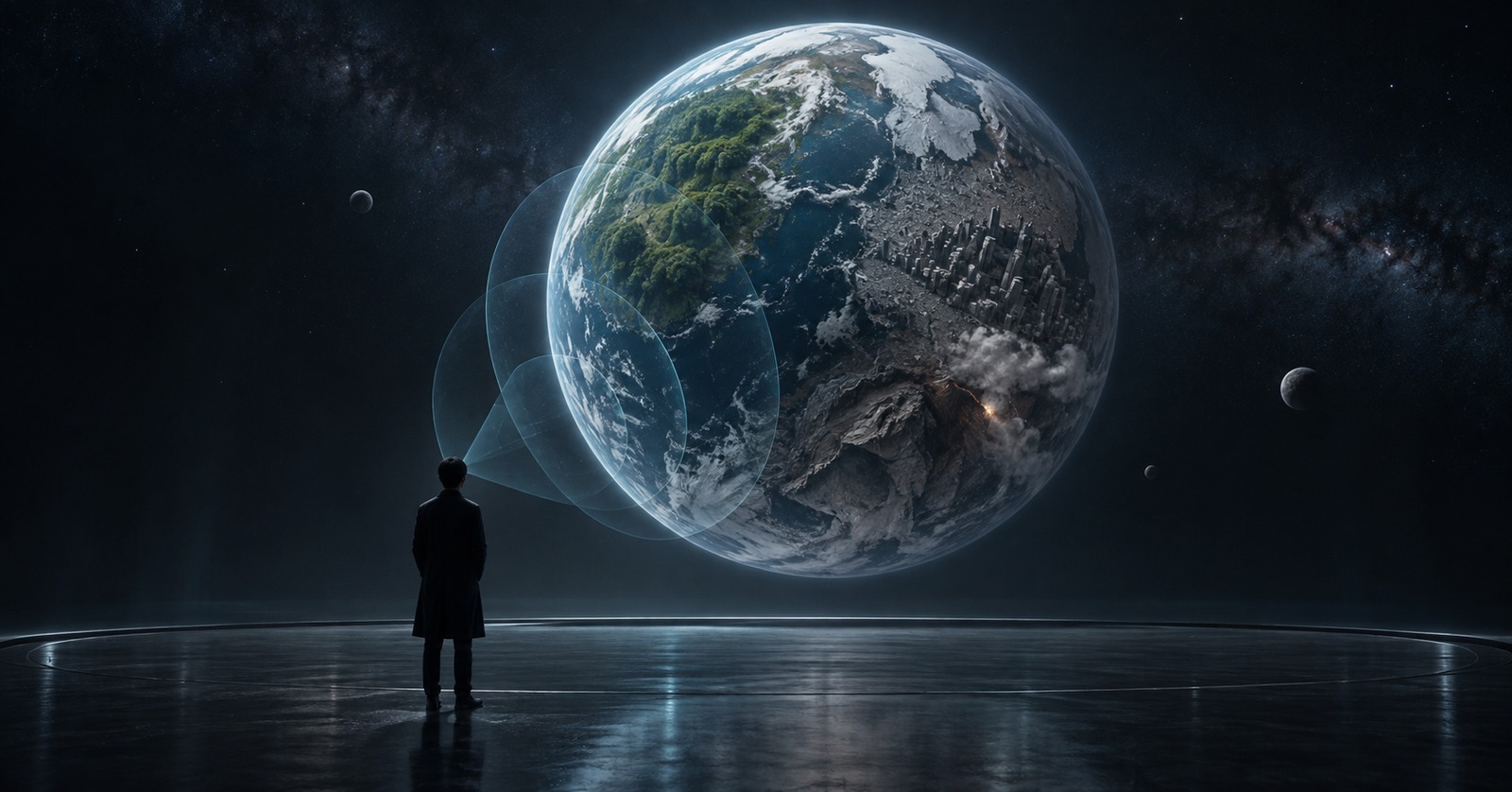
“Being born human gives meaning to leaving descendants.”
“Helping the species flourish is our natural mission as living things.”
Therefore, we should marry and have children. I sometimes encounter that reasoning.
It used to bother me intensely. Should humanity flourish in the first place?
We clear forests, pollute oceans, drive other organisms extinct, and consume vast resources. From the perspective of the planet as a whole, might humans be better absent?
If humanity keeps multiplying, might extinction be better for the Earth? Thinking that way, I didn’t want children myself. Bringing another human into this world even seemed somewhat cruel.
Without people, our structures would eventually decay. Plants would grow through roads, forests swallow buildings, and wildlife return.
Imagining that felt like the Earth returning to its original form. I still find that vision beautiful.
Recently, though, I’ve become interested in a deeper assumption.
Who feels pleased when humanity disappears and cities return to forest? The Earth? The universe? Or simply me?
Aren’t both “humanity should flourish” and “the Earth would be better without humanity” value judgments made by humans?
I thought I’d moved beyond a human-centered view by considering the whole Earth. Now I wonder whether the standard I called “good for the Earth” exists on the Earth’s side at all.
I personally prefer places rich in nature
Let me make that clear first. I’m not thinking this way because I dislike nature. Quite the opposite.
I find green places beautiful. I like forests and the sea, and landscapes with plants and wildlife appeal more than places covered in concrete.
Seeing nature lost through human activity feels wasteful.
The value judgment that a naturally abundant Earth is preferable certainly exists within me. I’m not trying to deny that feeling.
But my feeling something and the world possessing that value intrinsically aren’t the same.
A good environment for whom?
Consider crows. They’re wild animals, yet they live in large cities that even humans can find oppressive.
Concrete, traffic, rows of utility poles, and large quantities of human rubbish may look like lost nature to us.
For crows, the situation may differ. They find food, use tall buildings and poles, and live within an environment humans made.
I’m not claiming they find cities beautiful. Simply, some wildlife uses places humans regard as deprived of nature as habitat.
More forest suits some organisms. For species needing open grassland, increasing forest isn’t always beneficial.
A desert looks harsh to humans, but some organisms live there. The same applies to the deep sea.
It begins to seem useful to distinguish a state of abundant nature from the judgment that the state is good.
Humans also decide which nature to protect
The debate over whaling reveals something similar.
Some people believe whales shouldn’t be killed. They may value intelligence or rarity, or find particular value in huge creatures swimming through the sea.
Others ask why whales should be singled out while cows and pigs are eaten. Some want whaling preserved as food culture and livelihood.
I’m not trying to settle that dispute here.
Neither protecting whales nor preserving whaling culture is an answer supplied by the Earth itself.
Both standards arise from what people value.
Protecting nature or ecosystems can also involve eliminating invasive species. We kill one organism to protect another. The invasive organisms themselves are simply living and reproducing where they can.
Which historical ecosystem counts as original nature? Which organisms should remain, and which should be removed? Ultimately, humans decide using present knowledge and values.
This doesn’t make protecting nature meaningless. It means human choices are already contained in the phrase “protect nature.”
I wrote about questioning killing animals for food and actually trying a diet with no animal products in “Giving up on being perfectly good made life much easier”.
Does the Earth really want its nature back?
Watching images of cities covered by plants after humanity disappears, I’m tempted to say the Earth is recovering or returning to its original state. I understand that feeling.
But there’s no evidence that the Earth prefers forests or wishes for biodiversity.
The planet hasn’t always looked the same. It has experienced extensive ice cover, major volcanic activity, and repeated mass extinctions.
No standard is written somewhere declaring the current green Earth correct and every other state broken.
Physically, states change. It seems to me that the observer adds good and bad.
Rejecting human-centered thinking doesn’t remove human values
I used to think I should consider the Earth as a whole rather than what suits humans.
In not treating humans as uniquely special, that did broaden my perspective. Yet the judgment of what benefits the whole Earth is still human-made.
“The Earth would be better without humans” seems to step away from human-centered thinking. Underneath it, however, my own preferences remain: more greenery is good, more wildlife is good, fewer artificial structures are beautiful.
I may have removed humanity from the center, but a human remains as the one doing the evaluating.
That has made me more cautious about speaking from the Earth’s perspective. Is it really the Earth’s view, or a human image of an ideal Earth presented as though the planet had a will?
I can still love nature
None of this leads to “If it’s all human values, it doesn’t matter what happens to nature.”
I like places rich in nature. I want environments where many species can live, and where people can continue living too.
I just want to distinguish one thing: my wanting it isn’t the same as its being cosmically correct.
I can find forests beautiful, dislike pollution in the sea, and want wildlife to retain places to live.
While feeling that way, I can understand that these are also values held by this particular human. That fits better for me.
Observe my values too
Recently, after reaching a conclusion, I more often examine why I consider something good in the first place.
Previously, I used the value as a foundation and thought beyond it. Now the foundation itself becomes something to observe.
If I mistake my values for the world itself, things outside those values easily look wrong.
I may interpret new information to fit an existing conclusion or want to reject a different view. In extreme cases, preserving a worldview can lead to distorting reality.
But understanding that this is how things look to me now, rather than the truth of the world leaves room to change my thinking.
Other people also see through memories and values. I discussed that difference in “Don’t turn someone else’s judgment into my reality”.
I examined how someone else’s success becomes the success of a group we belong to in “Only when someone succeeds does it become our success”.
When I learn a new fact, I can update my view. When a different feeling appears, I can observe that too.
The purpose isn’t to weaken my values. It’s to have values without being bound by them.
Meaning and value existing in the world itself may differ from meaning and value arising within me.
I also wrote about the boundary between what I understand and what I leave unknown in “Not pretending to understand what I don’t: what knowing my ignorance means to me”.
I’m not seeing the world unfiltered; I’m seeing it through my values. Remembering that leaves room to revise my thinking again and again.
I want to observe my own values because I don’t want to lose that room.

コメント