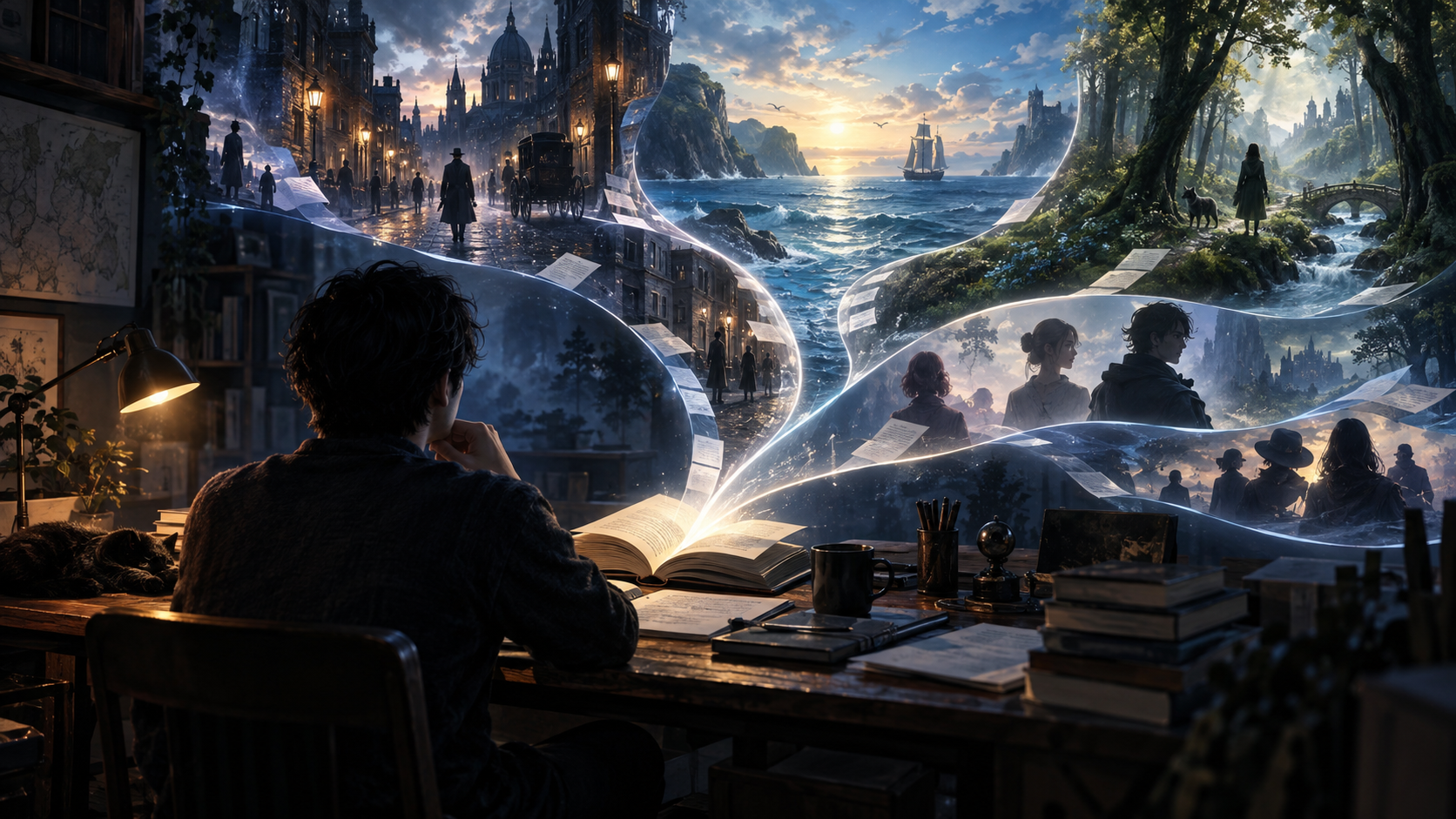
Separate from this blog, Mugen no Hamon, I’ve begun experimenting a little with making fiction using AI.
It started when I began reading books again.
I can enjoy novels again
I used to read far more fiction. During periods when I wasn’t working, I’d buy piles of secondhand books and read through them to pass the time.
Overseas, too, finding a shop selling Japanese books meant buying them cheaply and reading in spare hours.
Recently, though, I’d barely read. Debt and everyday life left little room.
It wasn’t that I had absolutely no time. More than that, I lacked the mental space to deliberately enter a fictional world.
As I’ve rebuilt my everyday life and physical condition, that has gradually changed.
I call the current state Mugen Mode. I can stay active longer and still have energy to write or think about other things after work. That has also restored enough mental room to enjoy things outside work.
So I started dipping into books I’d bought long ago and still had.
Could current AI make a long story I’d enjoy?
Reading novels again made me wonder.
Recent AI is impressive not just at producing prose. It can increasingly refer to supplied settings and earlier text, drawing on relationships and past events to continue a story.
Could it therefore make fiction suited to my tastes?
That casual thought led me to try making stories somewhere separate from this blog.
I originally only intended to test how long a story current AI could handle.
Older AI often forgot settings, changed characters’ personalities halfway through, or contradicted earlier passages when producing long texts.
I still wouldn’t leave it entirely unsupervised. But with the settings and earlier writing available, and a human checking along the way, long stories seem much easier to make than before.
When I had it try several plot developments and read what followed, my first reaction was, “Hang on—this is actually readable.”
In practice, though, the process itself was more interesting than the question of technical feasibility.
It feels more like playing inside a story than writing a novel
What’s the setting? What kind of person is this character? Do they help someone or abandon them? Does this event change their life, or change nothing?
The AI offers possibilities. I read, choose what I like, change what feels wrong, and try other routes.
It feels more like playing inside a story than writing a novel.
At one point I thought it felt a little like playing Kamaitachi no Yoru, a Japanese branching narrative game. Except I’m not confined to prepared choices: I can change the characters, the setting, and what happens next.
“Actually, it’s much freer than that—and more fun.” That better describes the feeling.
I’ve never particularly wanted to be a novelist. I haven’t spent years writing fiction, don’t place special value on completing a whole novel in my prose alone, and don’t crave recognition as a novelist.
For fiction, then, I have little resistance to letting AI produce the prose.
I don’t begin with the pride that it isn’t a real work unless I personally write this part. An unexpected development from AI can be more interesting.
I’d rather see something I couldn’t have imagined alone than devise everything myself. I keep what I like and discard what doesn’t work.
For now, this is much closer to a game than a solemn creative undertaking.
The purpose differs from occasions when I’d rather not use AI
Recently, I wrote “What only humans can do in the AI age: choose not to use AI”.
If you want to experience the process of drawing or writing with your own hands, delegating it to AI can remove the purpose itself.
This fiction experiment has a different purpose.
I’m not enjoying personally writing each sentence. I enjoy reading unexpected characters and developments, deciding what to retain, and exploring another possibility.
Here, AI isn’t taking the enjoyment away. Its presence makes this particular play possible.
As I continued, I wondered whether a style like this might become an established new way of engaging with fiction. Not a replacement for traditional writing, but another enjoyment: making a story and playing with it at the same time.
I don’t completely know my own taste either
The most interesting moments come when a development appears that I wouldn’t have chosen.
I read, thinking, “So that’s where it goes,” and what follows can be unexpectedly good. An action or change in relationships I didn’t imagine can suddenly make the story interesting.
Those moments show me that I don’t fully understand even my own preferences.
I could specify my ideal plot in detail and have AI follow it. Doing only that seems a waste.
I let it run a little, produce something unexpected, then change what I dislike. If something I would never have chosen catches my attention, I leave it in.
Trying different stories gradually reveals which characters attract me, which developments lose me, and which scenes move me.
Because I could finish quickly, I won’t rush
I’m not trying to complete a work immediately. I intend to continue on a small scale as a new hobby for a while.
I’ll note interesting settings, memorable characters, developments I liked despite never choosing them myself, and those that suddenly killed my interest.
I don’t know whether the same things will interest me when I reread them months later. A setting that seems brilliant immediately may feel unremarkable with time.
Conversely, something may stay with me for half a year.
Once enough of that material accumulates, I can share it all with AI and seriously assemble a work.
With a human checking the output, I think producing a book-length text in a short time is possible. That is precisely why I don’t need to hurry.
In an age when the volume we can make has grown rapidly, what we choose, discard, and retain may matter more than what we can produce.
At the moment, playing this way interests me more than finishing a novel.
Will it become a completed book, or will I get bored halfway through? I don’t know yet. So I’ll record this stage for now.
I explained how I reached a life where this play became possible in “What is Mugen Mode? When problems remain but the thoughts stop lingering”.
After writing this, I received ¥284 from image collections I’d made more than two years earlier. I reflected on how fiction and books might remain after completion in “A ¥284 payment gave me a glimpse of the future”.
Later, I tried advancing the novel during short waits between deliveries and found the combination surprisingly good. That day is recorded in “My AI novel kept growing while I waited between deliveries”.


コメント