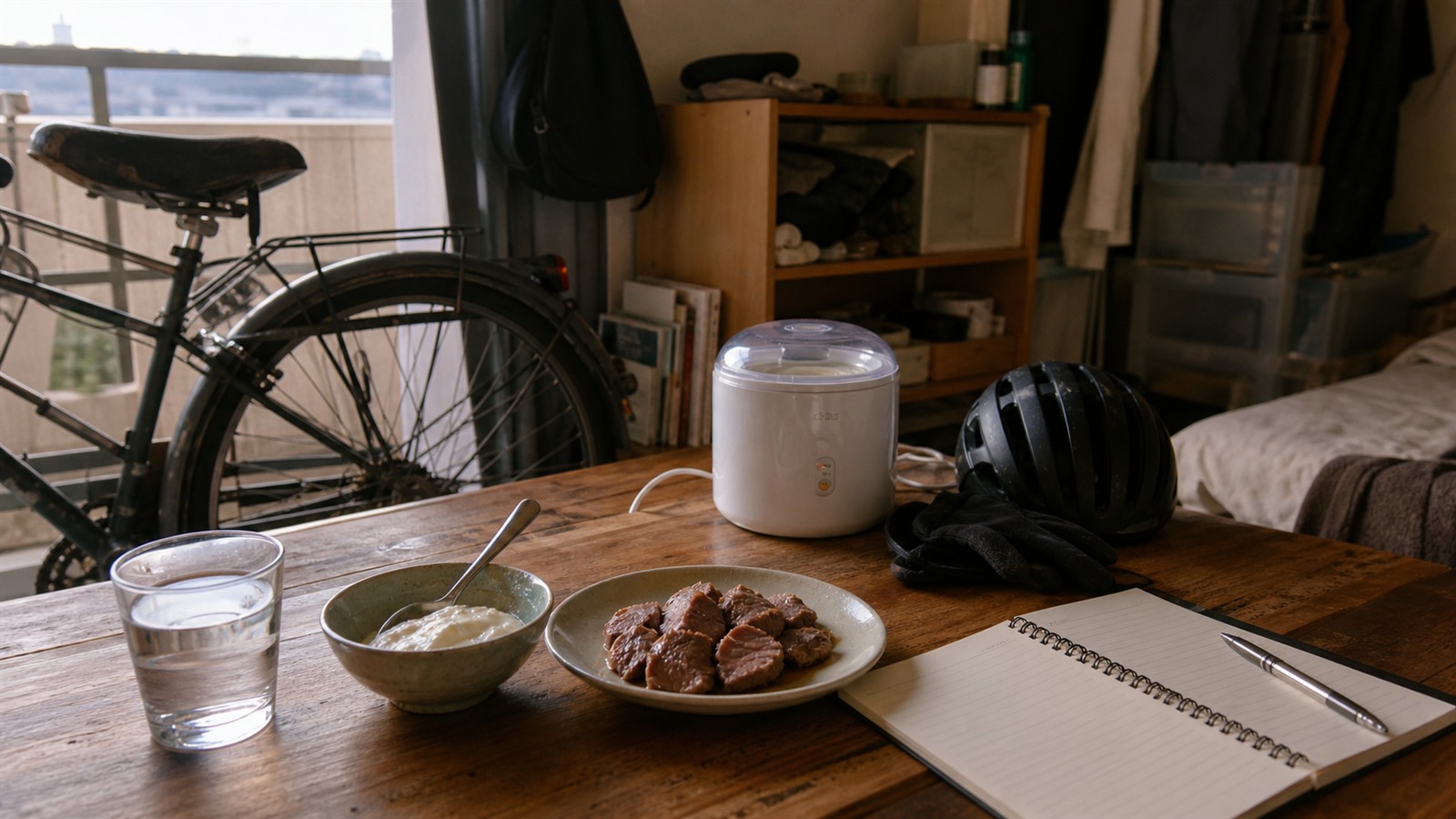
I owe ¥4.55 million. I deliver food on a non-electric mamachari, an everyday city bicycle, earning money for that day’s living expenses and repayments.
Looking only at that picture, some people might feel sorry for me. But I’m far happier now than I was before. I enjoy the simple repetition of making deliveries. When something unpleasant happens, I don’t keep dragging it around afterward. Even after work, I want to write for this blog, Mugen no Hamon.
I’m not making an effort to think positively. When my body is in good condition, this happens naturally. Sometimes I catch myself humming while I work.
I call this lightness of mind and body Mugen Mode. Of course, I can’t actually go on forever. I get tired and need rest. But even while doing the same job, this is an entirely different life from enduring the pain until the day is over.
I’ve described the state itself in “What is Mugen Mode? When problems remain but the thoughts stop lingering”. Here, I’ll record what I’m currently doing to create and maintain it.
There are six main practices. I’ve tried each in my own body and life; I’m not claiming that this combination will suit everyone.
1. Not drinking
What I do now: I don’t drink alcohol.
I like drinking. I enjoyed work drinking parties, and looking back, alcohol was almost always there when I spent time with friends. It was an important way of talking to people and growing closer.
When I worked in sales, I controlled my food quite strictly but drank almost every day. I especially liked beer. I drank with colleagues and bought cases of slightly expensive German beer for home.
Alcohol wasn’t simply the one bad habit left in my diet. It broke the tension of chasing numbers, connected me with colleagues and managers, and marked a good sales day. In the life I was fighting through as a salesperson, it served a purpose.
So I don’t think that if I’d only stopped drinking then, I would have reached the state I’m in now. I don’t know whether I could have kept working that way with the same intensity without alcohol. I’m not going to treat my present judgment as the only correct answer and rewrite the past around it.
I had more than one or two painful failures involving alcohol and still kept drinking. It was so constantly at my side that I hardly thought of it as separable from life.
At the same time, I knew very well that it reduced my performance. The absolute excuse—“You’ve got to enjoy life”—won anyway.
But after experiencing how success and freedom failed to sustain happiness, I began thinking about happiness that could continue through an ordinary day when nothing special happened. Wasn’t health a prerequisite? As I reviewed food, sleep, and movement, I couldn’t see a way around stopping drinking.
I’m not staying off alcohol now because I have more willpower. I’m no longer living the life of battling numbers and relationships every day, then dealing with the rebound through drinking. I’ve changed more than one indulgence: how I spend time with people, and how I arrange work and life, have changed too.
That doesn’t mean I’ve never drunk again since. After low-temperature-cooked meat brought a major change in my condition, I tried drinking to see whether I might now be able to manage it.
Then I discovered that the large quantities of peanuts I’d eaten as drinking snacks didn’t suit me. I wondered whether some of my earlier poor condition had been caused by those as well. What would happen if I changed the food and tried alcohol on its own?
Because I like drinking, I wanted to know whether there was room for it without disrupting my life. There were indeed days when I didn’t feel as heavy as before and could move normally. But being able to move and being able to enjoy the day turned out to be different things.
The repetition of deliveries that felt blissful without alcohol became intensely boring. My legs worked, but I didn’t want to keep doing the same thing. The desire to write faded too.
In an earlier experiment, it took roughly two weeks from the last drink to return to the Mugen Mode I use as my benchmark. I wasn’t unable to work for two whole weeks. I returned much sooner to a condition where I could live normally and do my job. Getting back to having energy left afterward and naturally enjoying quiet, ordinary things took longer.
I used to worry about how bad I felt the day after drinking. Now I’m comparing something else: the pleasure of drinking against the pleasure of living in this state.
Dropping out of it again and spending days climbing back is simply a nuisance. For me now, not drinking is less about self-denial than preserving a life I don’t want to give up.
I didn’t stop drinking to abandon pleasure. I stopped to enjoy more of everyday life. I’ve written about that in “A true hedonist lives quietly”.
My earlier thinking about abstinence and endurance is in “You can’t stop drinking by simply putting up with wanting a drink”.
2. One main meal a day
What I do now: I generally have one main meal a day, have honey while working, and eat a little along the way if I need to.
I used to eat three substantial meals a day. When I questioned that pattern and tried two, I felt better and had more time when I could move with a clear head. After more trial and error, I eventually arrived at one meal a day.
This isn’t a recent habit. Around ten years ago, while working in sales, I followed a fairly strict one-meal routine centered on meat and fish, with almost no staple foods such as rice or bread.
But I was drinking almost every day then. It wasn’t the same life as my present Mugen Mode. One meal a day and leaving out staple foods laid part of the foundation, but they weren’t enough by themselves to produce my current condition.
After I left that job, my eating habits loosened considerably. There were days of heavy drinking and gorging on junk food. Even so, the tendency to center meals on meat remained, and returning to one meal a day never became a particular struggle.
These days, it doesn’t feel as unnatural as when I first started. Rather than holding myself back to keep it to one meal, this frequency has become normal.
Eating makes me tired. The reaction is quite clear, and I suspect I feel post-meal fatigue more strongly than people around me. On past trips with friends or a partner, every meal left me struggling and reluctant to go to the next place. Everyone else seemed fine, while I wanted to go back to the room and rest.
Reducing the number of meals wasn’t simply a way to cook less. It was a way to spend less time feeling heavy afterward and more time able to move.
It wasn’t that I forced myself not to eat because I didn’t want to interrupt work. This frequency suited my body, and as a result, deliveries and writing became easier to continue.
Recently, I’ve started taking honey during work. When I’m tired, I sometimes have a small portion of my usual meal partway through and take a nap if I need one. I feel that doing so no longer disrupts my condition as much as it once did, so I adapt to the day instead of insisting on exactly one meal.
3. Meat at the center, keeping what suits me
What I do now: I generally leave out staple foods such as rice, bread, and noodles, center meals on meat, and combine it with eggs, okra, and other foods. I have honey during work and don’t eat nuts.

Meals high in carbohydrates tend to leave my body feeling heavy. When I center a meal on meat, that drop is smaller.
Recently, I put staple foods back in for several consecutive days. I could move normally on the first day, but over the second and third, my recovery worsened. Even my ability to feel happiness while making deliveries became duller.
That didn’t lead me to conclude that I should eat nothing but meat. After I started low-temperature cooking, reducing vegetables no longer left me constipated, so for a while I almost stopped buying frozen vegetables.
That cleared room in my small freezer for more meat, which was very convenient. Later, though, I began to lose the physical lightness I’d felt. At first I blamed the extreme heat. When I tried bringing back okra, the way my body moved changed clearly.
Having regular bowel movements and having my body function at its best weren’t the same thing.
In the other direction, removing the peanuts I’d been eating in large quantities—partly because I thought of them as healthy—improved my condition. It wasn’t only next-day heaviness and fatigue. I noticed a difference in irritability during deliveries too.
I’d also eaten almonds and walnuts for years, thinking they were good for me, though I had noticed that too much didn’t feel good. The change with peanuts prompted me to stop eating nuts altogether for now. I don’t miss them, and I actually feel better without them.
What it is about okra that matters, or what it was about peanuts that didn’t suit me, I don’t know in detail. But I decide what to eat next by looking at the changes that actually occurred.
More recently, I’ve added honey as fuel during long bicycle shifts. I tried ice cream and soft drinks too, but honey has been easiest for me to manage, and my physical condition feels most stable with it.
Honey contains carbohydrates as well, but the amount and timing differ from eating staple foods over several days. I don’t yet know whether something specific to honey matters or whether carbohydrate intake suits my current level of activity.
I’m not eating to defend the label of a meat-based diet. I look beyond bowel movements to how I function after eating, the next morning, during work, and into the night. This is the combination that has remained as a result.
The record of changes to my food
Here are the experiments that led to the present combination, in chronological order.
- July 6, 2026: “Upgrading my meat-based diet: how giving up the frying pan made life more comfortable”. Introducing low-temperature cooking changed how light my body felt after meals and the following morning.
- July 19, 2026: “It was my body, not the location, that made digital-nomad life possible”. After improving my food, I tried alcohol again and recorded losing that condition and returning to it.
- September 27, 2026: “A few days of carbohydrates disrupted Mugen Mode”. I brought back staple foods for several days to see what happened to recovery and how deliveries felt.
4. Cooking blocks of meat at a low temperature
What I do now: I buy blocks of meat at places such as Gyomu Super, a Japanese discount grocery chain, and batch-cook them at a low temperature in a yogurt maker.

Of the six habits, this was a particularly significant turning point. Cooking continues while I’m making deliveries, so I don’t have to start preparing food when I get home. There’s no splattering oil, hardly any lingering smell, and little washing up because I don’t use a frying pan or stove.
Above all, cheap meat tastes good. Even meat that costs around ¥100 per 100 grams becomes something I want to eat every day. I’m not sacrificing taste to save effort.
My body’s response was also clearly different from when I seared meat hard at a high temperature. It felt easier on my stomach after eating, and there was a difference the next morning too.
I’ve tried different ways of eating for more than twenty years, and this wasn’t just a small improvement. I had energy left after long rides, even enough desire to write while I was out.
Later, I sometimes lost that condition by changing the food or introducing alcohol. I’ve also watched the process of restoring the conditions and becoming able to move again. So I no longer treat this as merely the temporary excitement of trying something new. Low-temperature-cooked meat is central to maintaining my present life.
But it didn’t determine everything on its own. The state I’m in now is the result of adjusting okra, peanuts, and whether I drink, as well as the meat.
I recorded the specific changes when I started in “Upgrading my meat-based diet: how giving up the frying pan made life more comfortable”.
5. Yogurt fermented for 36 hours
What I do now: I used to eat homemade yogurt fermented for 36 hours in a yogurt maker, but for now I have left it out to see how my condition changes.
When I introduced it alongside a meat-centered diet, my digestion felt more stable and the next day’s fatigue seemed lighter. That’s why I kept it, but honestly, I don’t know how much it’s contributing within my present diet.
I haven’t completely separated the effects of yogurt from the other food or from not drinking. I’m not measuring bacterial counts or lactose levels either. I’m watching what happens to me with the current combination.
I can make both the meat and the yogurt with the same type of small appliance. That simplicity was one reason I kept doing it.
Still, the work of preparing it had started to bother me a little. On November 16, 2026, when my prepared batch ran out, I decided to stop eating it for a while. I don’t yet know how my condition will change. I recorded that decision in “I’m Trying Life Without My 36-Hour Yogurt”.
6. Moving regularly through physical work
What I do now: work that involves a substantial amount of movement, such as food delivery. From my own experience, at least about five hours a day serves as a rough guide.

By physical work, I mean a job where I actively use my body—pedaling, walking, carrying out tasks—not simply being present at a workplace.
Five hours is a guide drawn from my own experience of this work, not an amount of exercise everyone needs. Jobs and workloads differ, so I look at my body and mood afterward rather than judging by the clock alone.
Money isn’t my only reason to move. After warehouse or cleaning work, I’ve felt an indescribable happiness pass through my body.
“Oh. This was enough.”
I hadn’t achieved a great success or solved my problems. I’d simply worked a day, got hungry, and found the food delicious. That alone brought the day’s life to a kind of completion.
When I try to process anxiety and impatience entirely in my head, I keep thinking about the same things indefinitely. After moving, I can often respond where necessary without continuing to drag the rest around.
I’m not trying to forcibly silence anxiety. I look at what I’m reacting to and deal with it if it’s a real problem. At the same time, I check whether fatigue or a lack of sleep is making everything feel heavy.
Movement is also necessary for me to keep thinking and writing. I don’t expect that need to disappear even if I eventually earn enough from blogs or books to live on.
For now, my basic plan is a 13-hour working window, including waiting, breaks, and writing, to cover expenses and repayments. Various experiments and busy periods have meant I haven’t actually been following that window consistently, so I’ll test it again in the coming quiet season.
That’s a division of time intended to produce the income I need. It doesn’t mean I need to work thirteen hours to feel bliss.
Eventually, I want to adjust it to the amount that supports my body and creative work. The difference will be in the quantity and how much I can decide for myself.
Feeling good doesn’t mean I have to use up every last bit of energy. I could do more, but this is enough for today. I want to preserve that margin too.
Being able to work is no longer enough to call it “good”
I don’t judge my current state only by bowel movements or how I feel on waking. I watch the lightness of my body and my mood while eating, afterward, during the working day, and when I go to bed.
Recently, whether I want to start something, write, or enjoy repeating a task has become another clear measure. Even music sounds different. A feeling of being moved that had faded has returned, and I naturally want to sing and pick up a guitar.
I probably would once have called simply being able to work a sufficiently good condition. Now I know a state beyond that: my body is light, work isn’t painful, and afterward I can still turn toward what I want to do.
When that happens, even the same debt and future look different. I didn’t become happy because the debt disappeared. I live while repaying it, and more of that life has become enjoyable.
There is no special significance to the number six. Sleep and rest still matter, and following six items doesn’t mean I’ll feel good no matter what. I’ve simply organized the main habits behind my present life into six parts.
Making it easier to continue when work or location changes
This combination has another advantage. It doesn’t require a large kitchen setup, and the daily procedures are few, so it may be easier to take with me when work or location changes.
I live in an ordinary studio apartment with a kitchen. In that setting, I choose low-temperature cooking and homemade yogurt. These aren’t second-best substitutes forced on me by the absence of a kitchen. They’re food I currently like.
I haven’t verified that I could take one appliance and do exactly the same thing in any dormitory or hotel. I’d have to check the rules for cooking and appliances, available refrigeration, and access to ingredients at each destination.
Still, knowing what I need gives me criteria for choosing a room or somewhere to stay. It may save me from having to discover a suitable diet from scratch every time I move.
If food delivery stops working
If I can no longer make deliveries work, I’ll return to employment to cover expenses. Factory contract work, warehouse sorting, cleaning: I’ll choose from the jobs available at the time.
I once avoided factory contract work because it felt as though a prison-like life was about to begin. I describe that in Episode 1. But changing jobs doesn’t mean I intend to abandon a life in which I look after my body and keep writing.
How would I rearrange meals and sleep around the working hours? If accommodation came with the job, what could I do in my own room? I’d look at the conditions and find a form I could continue.
Having another option in mind also helps me avoid excessive fear of account suspension or ratings during deliveries. That doesn’t mean doing the job carelessly. It means doing what needs doing without putting everything in the hands of one particular job.
I can’t leave my physical condition behind when I go abroad
If I eventually live while moving between places, falling ill every time I move won’t give me the life I want.
Even while delivering in the same city, I can enjoy it like a journey when I’m in good condition. When my body and mood deteriorate, movement and unexpected events become nothing but a nuisance. I’ve experienced that already.
So whether I can maintain my present condition somewhere matters as much as where I go. Being able to continue low-temperature cooking and fermentation with small appliances is one reason the plan has become more concrete. How much I can actually reproduce elsewhere is something I’ll find out when I move.
From finding a way to feel well to living with the body I’ve built
For over twenty years, I’ve searched for ways to move with less difficulty, trying things and changing what didn’t suit me. I’ve continued testing the smaller details recently too.
My current Mugen Mode isn’t simply a return to how I ate ten years ago, or that old routine with alcohol removed. It’s the first time I’ve brought one main meal a day, meat-centered eating, not drinking, low-temperature cooking, and regular movement and rest together this fully within my present life.
There are foods I haven’t tested individually and habits I’m still adjusting. Even so, the broad outline has become fairly clear. With what I’ve learned through all that trial and error, I want to think about what to do while maintaining this condition.
If my body or circumstances change, I’ll adjust. But I don’t have to go back to knowing nothing. I’m clearer now about what brings me down and what condition I want to return to.
From here, I’ll continue my basic food routine, stay off alcohol, and move sufficiently through work. While living that life, I’ll write books and keep updating Mugen no Hamon.
I’m not looking after my body so that I can spend the rest of my life doing nothing but health management. I’m doing it to enjoy today and actually do the things I want to do.
I’ve written about why I see this life as part of success in “If you’re successful but unhappy, that’s failure: what success requires for me”.
The English edition of my first book, Happiness Starts with Reality, is now available on Amazon Kindle. The Japanese edition is still being revised. Publication updates and the other books I’m developing, including work on looking after my body, are on the books page.
Mugen no Hamon / A record of looking after my body